If you're a fintech or startup CTO searching for the best server hardening company for startups, you already know the stakes: a single misconfigured port, an outdated SSH policy, or a missed patch can trigger a breach that wipes out investor confidence and triggers regulatory penalties overnight. Choosing the right server hardening partner isn't a checkbox exercise — it's a decision that determines whether your infrastructure survives its first audit, its first pen test, and its first real attack. This guide breaks down exactly what to look for, how vendors compare, and why fintech teams increasingly choose CloudHouse Technologies to lock down their production environments.
Why Fintech and Startup CTOs Can't Treat Server Hardening as an Afterthought
Fintech platforms sit at the intersection of sensitive financial data, regulatory scrutiny, and constant attacker interest. Unlike a typical SaaS product, a fintech server stack must satisfy PCI DSS if it touches card data, SOC 2 Type II if it wants enterprise customers, and often GDPR if it serves EU users. Server hardening — the process of reducing your attack surface by disabling unused services, enforcing least-privilege access, patching aggressively, and locking down configurations — is the technical backbone that makes all of those compliance frameworks achievable.
Startups frequently underestimate this because early-stage engineering teams are optimized for shipping features, not securing infrastructure. That's exactly why so many fintech founders start searching for the best server hardening company for startups the moment they land their first enterprise client or begin prepping for a SOC 2 audit.
What Server Hardening Actually Involves
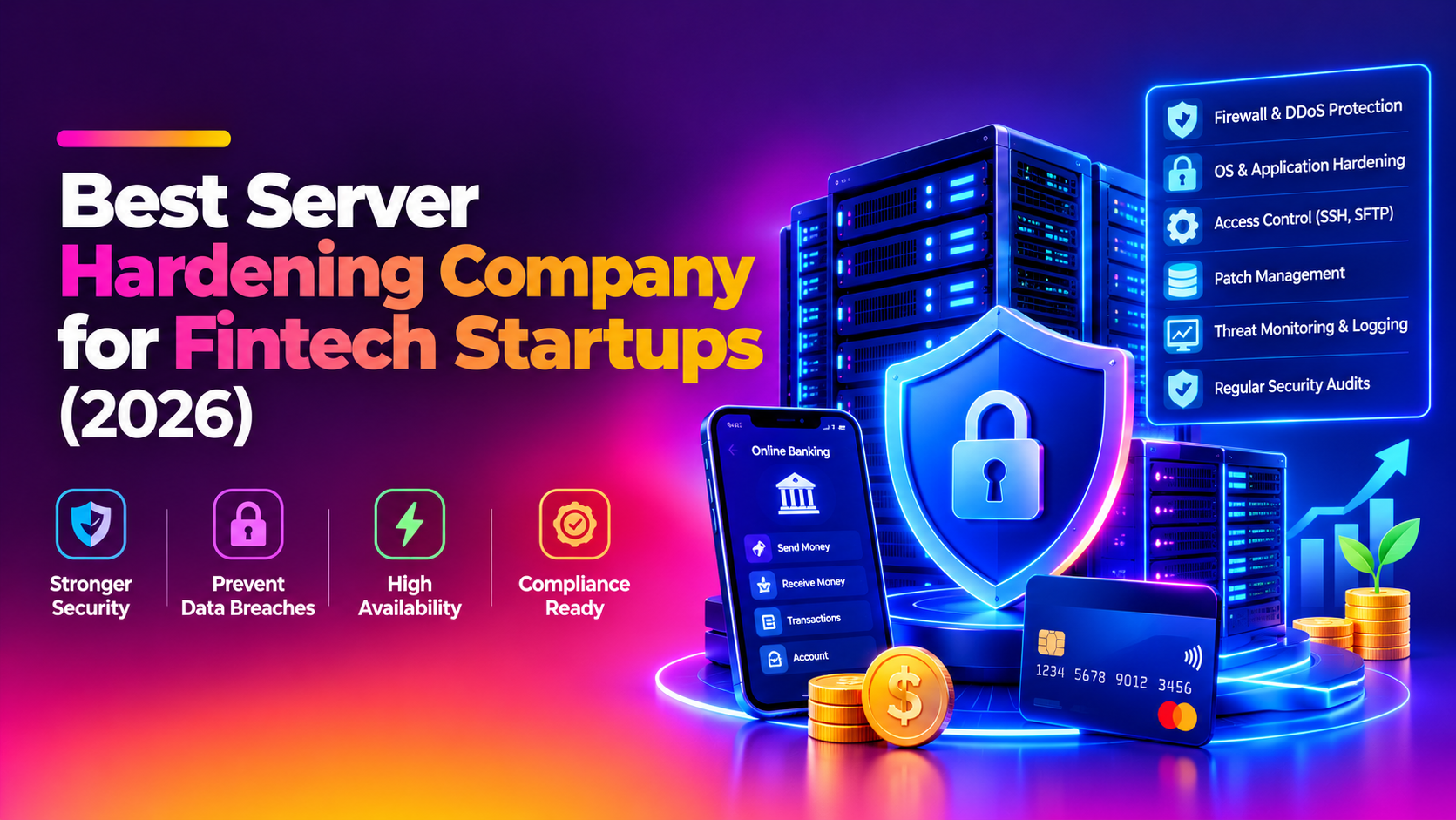
A genuine hardening engagement goes far beyond installing a firewall. A competent provider should address every layer of your stack:
- OS-level hardening — disabling unused services, removing default accounts, applying CIS Benchmarks for Linux or Windows Server
- SSH and access control — disabling root login, enforcing key-based authentication, implementing MFA and bastion hosts
- Network segmentation — isolating database tiers from public-facing application servers, restricting east-west traffic
- Patch management — automated, tested patch cycles rather than ad-hoc manual updates
- Logging and monitoring — centralized audit trails covering authentication, privilege escalation, and file integrity, which SOC 2 and PCI DSS explicitly require
- Encryption — data at rest and in transit, with proper key management
- Configuration baselines — documented, version-controlled server configs that can be audited and rolled back
If a vendor's pitch stops at "we'll install a firewall," keep looking. Real hardening is systematic, documented, and repeatable across every server you spin up — a discipline CloudHouse Technologies builds directly into its server hardening service.
How to Evaluate the Best Server Hardening Company for Your Startup
Not every vendor that offers "security services" is equipped to handle fintech-grade hardening. Use this checklist when comparing providers:
1. Compliance Fluency
Ask candidates directly: have they hardened servers for clients pursuing PCI DSS, SOC 2 Type II, or HIPAA? A provider that can map their hardening controls directly to specific compliance requirements will save you months during your audit prep.
2. Proven Fintech or Regulated-Industry Experience
Generic IT support firms often lack exposure to the specific threat models fintech companies face — card data exposure, wire fraud, API abuse, and insider threat. Look for case studies or references from similar-stage companies.
3. 24/7 Response and Ongoing Maintenance
Hardening isn't a one-time project. New CVEs, dependency vulnerabilities, and configuration drift appear constantly. The best providers offer continuous monitoring and rapid patch deployment, not just a one-off audit report.
4. Transparent, Documented Methodology
You should receive a clear before/after configuration report, a written hardening baseline, and documentation your auditors can review — not just a verbal assurance that "it's been handled."
5. Realistic, Transparent Pricing
Beware vendors that quote a flat number without first assessing your infrastructure. Reputable firms scope pricing based on server count, complexity, and compliance targets, and are upfront that ongoing hardening maintenance is a recurring cost, not a one-time fee.
6. Fast Onboarding Without Cutting Corners
Startups move fast, but a rushed hardening job is worse than none — it creates false confidence. The right partner balances speed with rigor, typically delivering an initial hardening pass within 1-2 weeks and a full compliance-ready baseline within 4-6 weeks.
Comparison: How to Score Server Hardening Vendors
| Evaluation Criteria | Generic IT/MSP Vendor | Security-Only Boutique | CloudHouse Technologies |
|---|---|---|---|
| Fintech / compliance experience | Limited | Variable | Dedicated PCI DSS / SOC 2-aligned hardening |
| 24/7 ongoing monitoring | Rare | Often extra cost | Included in support plans |
| Documented before/after baseline | Rarely provided | Sometimes | Always provided |
| Combined server management + hardening | Rare | Rare (security-only) | Full-stack support |
| Startup-friendly onboarding speed | Slow | Moderate | 1-2 week initial pass |
| Transparent, scoped pricing | Flat, opaque | Variable | Scoped to infrastructure and compliance goals |
💡 None of these worked? Skip the guesswork.
Get Expert Help →Why CloudHouse Technologies Is a Strong Fit for Fintech and Startup Teams
CloudHouse Technologies has built its server hardening service specifically around the reality that startups need enterprise-grade security without enterprise-grade delays. The engagement typically covers:
A full review of your current server configuration, open ports, user accounts, and existing patch status to establish a baseline risk profile.
Applying industry-standard hardening baselines across Linux and Windows Server environments, tailored to your specific stack and compliance targets.
Enforcing key-based SSH, disabling root logins, implementing MFA, and setting up bastion hosts or VPN-gated access to production.
Ongoing monitoring for new CVEs and scheduled patch cycles so your hardening posture doesn't degrade over time.
Delivering the configuration reports and logs your compliance team or external auditors will need for SOC 2 or PCI DSS assessments.
Common Buyer Objections, Answered
Founders evaluating a hardening partner usually have the same three concerns: cost, trust, and timeline. On cost, most fintech startups find that a dedicated hardening engagement is significantly cheaper than the cost of a single breach, downtime incident, or failed audit cycle. On trust, ask any candidate vendor for references from similarly regulated clients and insist on a documented methodology rather than vague assurances. On timeline, a competent provider should give you a realistic phased plan — initial critical fixes within days, full baseline hardening within weeks — rather than an unrealistic "done tomorrow" promise that signals corner-cutting.
Red Flags to Avoid When Choosing a Vendor
- No mention of specific compliance frameworks (PCI DSS, SOC 2, HIPAA) in their proposal
- Refusal to provide a written before/after configuration report
- One-time engagement only, with no ongoing patch or monitoring option
- Pricing quoted before any infrastructure assessment
- No references from fintech or regulated-industry clients
What a Server Hardening Engagement Should Actually Cost
One of the most common questions fintech founders ask is what a realistic budget looks like. While every environment is different, here's a general breakdown of the cost drivers you should expect a transparent vendor to walk through with you:
- Number of servers and environments — production, staging, and disaster-recovery environments typically all need hardening, not just the live production stack
- Compliance scope — a PCI DSS engagement with cardholder data environments generally requires more extensive segmentation work than a SOC 2 Type II readiness project
- Existing security debt — servers that have never been patched or reviewed require more remediation hours than infrastructure with an existing baseline
- Ongoing maintenance cadence — monthly patch cycles and continuous monitoring cost more than a single point-in-time hardening pass, but they are what keep your posture compliant year-round
Any vendor unwilling to explain these cost drivers before quoting a number is a red flag. The best server hardening company for startups will walk you through exactly what you're paying for and why, tying every line item back to a specific risk or compliance requirement.
Tools and Standards the Best Vendors Actually Use
Beyond process, the tooling a vendor relies on tells you a lot about their maturity. Look for providers who reference recognized standards and tooling rather than proprietary, unverifiable methods:
- CIS Benchmarks — the industry-standard configuration baselines for Linux, Windows Server, and major databases
- Vulnerability scanners such as OpenVAS, Nessus, or cloud-native scanning tools integrated into CI/CD pipelines
- Configuration management via Ansible, Puppet, or Chef so hardening baselines are version-controlled and repeatable rather than manual one-off changes
- Centralized logging platforms (e.g., ELK stack, cloud-native SIEM tools) to satisfy the audit-trail requirements baked into SOC 2 and PCI DSS
- Intrusion detection and file integrity monitoring to catch unauthorized changes to hardened configurations after the fact
When a provider can name the specific tools and standards they apply — rather than speaking only in vague marketing terms — that's a strong signal they can back up their hardening claims with evidence your auditors will accept.
Signs You Need a Server Hardening Partner Right Now
Some fintech and startup teams wait too long to bring in dedicated hardening expertise. Consider it urgent if any of the following apply to your organization:
- You're preparing for your first SOC 2 Type II or PCI DSS audit and don't have documented server configuration baselines
- Your engineering team has root SSH access enabled with password authentication still active on production servers
- You've never run a formal vulnerability scan against your production environment
- You're onboarding your first enterprise customer who requires a security questionnaire or vendor risk assessment
- Your infrastructure has grown organically without a documented, repeatable server build process
If two or more of these describe your current situation, it's a strong signal that partnering with a dedicated hardening provider — rather than leaving it to an already-stretched engineering team — is the faster, safer path to a compliance-ready posture.
Final Thoughts
Selecting the best server hardening company for startups is one of the highest-leverage security decisions a fintech founder can make. The right partner doesn't just close ports and patch software — they build a documented, auditable, continuously maintained security baseline that protects your customers' data and accelerates your path to SOC 2 or PCI DSS certification. If you're preparing for your first compliance audit, scaling past your first few production servers, or simply tired of losing sleep over unpatched CVEs, CloudHouse Technologies' server hardening experts can assess your infrastructure and deliver a compliance-ready hardening baseline fast.
Frequently Asked Questions
How much does professional server hardening cost for a startup?
Pricing depends on the number of servers, current security posture, and compliance targets, but most startups find a dedicated hardening engagement far cheaper than the cost of a breach, downtime, or a failed SOC 2 audit. Reputable vendors like CloudHouse Technologies scope pricing after an initial infrastructure assessment rather than quoting blindly, so you only pay for what your environment actually needs.
How do I know I can trust a server hardening vendor with production access?
Look for vendors that provide documented methodologies, before/after configuration reports, and references from similarly regulated clients. A trustworthy provider will also use scoped, auditable access controls (like temporary credentials or bastion hosts) rather than requesting unrestricted root access to your servers.
How long does a full server hardening engagement take?
Most fintech-focused hardening projects deliver an initial critical-fix pass within 1-2 weeks, with a complete, compliance-ready baseline — including documentation for SOC 2 or PCI DSS auditors — completed within 4-6 weeks depending on infrastructure complexity.
Is server hardening a one-time project or an ongoing service?
It should be ongoing. New vulnerabilities, dependency updates, and configuration drift emerge continuously, so the best providers pair the initial hardening pass with continuous monitoring and scheduled patch management rather than a single audit report.
Do I need server hardening if I'm already hosted on AWS or GCP?
Yes. Cloud providers secure the underlying infrastructure, but under the shared responsibility model, you are still responsible for hardening your operating system, applications, access controls, and configurations. Cloud hosting reduces some risk but does not eliminate the need for dedicated server hardening.