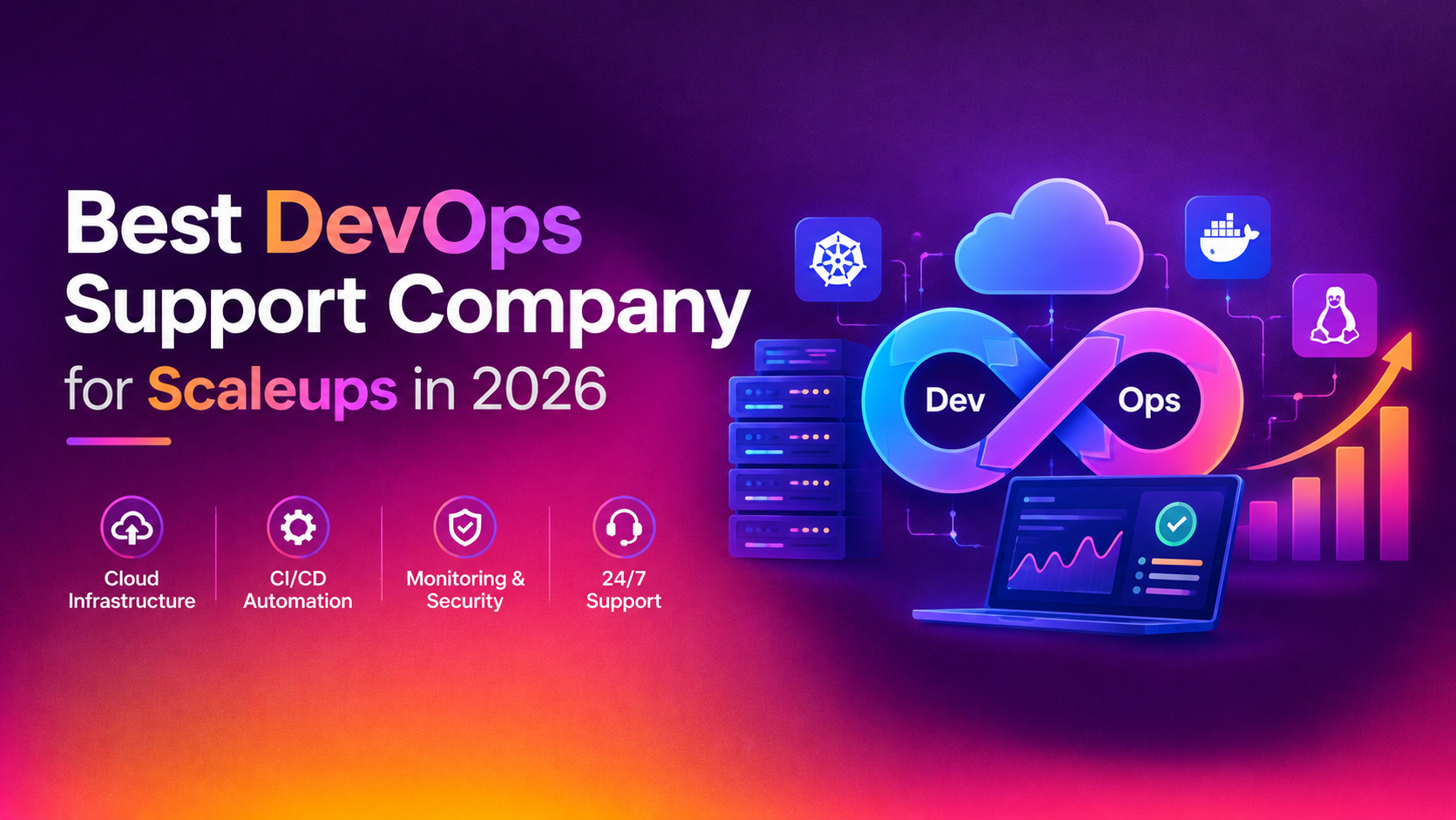
If your engineering team is stretched too thin to own CI/CD pipelines, cloud infrastructure, and on-call rotations reliably, you're not alone — and the vendor you pick to fill that gap can make or break your next twelve months. Finding the best devops support company for scaleups in 2026 isn't about who has the flashiest logo wall; it's about response times, real SLAs, and engineers who understand what breaks when a scaleup ships fast. This guide breaks down what actually separates elite providers from the rest, what the market charges, and how to make a decision you won't regret in month three.
Why Scaleups Struggle to Own DevOps In-House
Scaleups sit in an awkward middle: too big to run infrastructure on founder goodwill, too lean to justify a ten-person platform team. Engineers who were hired to build product features end up firefighting failed deploys, patching Kubernetes clusters at 2am, and manually rotating secrets — none of which moves the roadmap forward. The result is a familiar pattern: velocity drops, incident frequency climbs, and the best engineers start looking for a company that doesn't ask them to be on-call every other week.
This is exactly why DevOps support services for startups and scaleups exist — to absorb the operational load so product teams can stay focused on shipping. But not every provider is built for the pace and unpredictability of a scaling company, and picking the wrong one introduces a different set of risks.
The Real Cost of Picking the Wrong DevOps Vendor
An outsourced devops team that doesn't understand your stack, communicates through ticket queues instead of Slack, or takes six hours to acknowledge a P1 alert isn't a cost saving — it's a liability. We've seen scaleups lose entire release cycles because a vendor's "24/7 support" turned out to mean a shared queue monitored during business hours in a different time zone. The pain point isn't just finding help; it's finding help that won't become the next outage.
Common failure patterns worth watching for:
- Vague SLAs with no penalty or credit structure when response times slip
- Junior engineers assigned to production incidents with no senior escalation path
- Pricing that balloons once you're past the "starter" tier
- No hands-on CI/CD experience with your specific toolchain (GitHub Actions, GitLab CI, ArgoCD, etc.)
- Month-to-month lock-in disguised as "annual contracts only"
What Separates the Best DevOps Support Companies in 2026
Market research into DevOps as a service providers this year shows pricing anywhere from a few thousand dollars a month for targeted support up to $15,000+ for fully managed, dedicated coverage. But price alone tells you nothing about quality. The providers scaleups actually keep past the first renewal share four traits.
1. Real Incident Response Times, Not Marketing Copy
"24/7 support" means nothing without a number attached. Ask every vendor: what is your guaranteed time to acknowledge a P1 incident, and what is your guaranteed time to resolution or mitigation? Top-tier providers commit to sub-15-minute acknowledgment and publish their historical SLA compliance — not just a promise in a sales deck.
2. Deep CI/CD Expertise, Not Generic Cloud Ops
A ci/cd support provider worth hiring should be able to speak fluently about your exact pipeline — build caching, flaky test quarantine, progressive delivery, rollback automation — not just "we manage your AWS account." Ask for a walkthrough of how they'd optimize your current pipeline in the first 30 days.
3. Transparent, Predictable Pricing
The best vendors quote a flat monthly retainer scoped to your infrastructure size, with clear tiers for added scope (multi-region, compliance audits, extra on-call coverage). Be wary of anyone who can't give you a number without a two-week "discovery" sales cycle.
4. Senior Engineers on the Front Line
When you hire devops support company services, you're paying for judgment under pressure. Confirm who actually answers the page at 3am — a senior SRE with context on your systems, or a rotating junior support desk reading a runbook they've never tested.
Comparing Top DevOps Support Vendor Types
| Criteria | Boutique / Fractional DevOps Team | Large Managed Services Firm | Solo Freelancer / Contractor |
|---|---|---|---|
| Response time (P1) | Typically 15-30 min, senior engineer | Varies widely, often ticket-queue based | Best-effort, no coverage guarantee |
| CI/CD depth | High — hands-on pipeline redesign | Moderate — standardized playbooks | Depends entirely on the individual |
| On-call SLA | Documented, credit-backed | Exists but often generic | Rare, informal at best |
| Pricing transparency | Flat monthly retainer, clear tiers | Complex, enterprise-style contracts | Hourly, unpredictable at scale |
| Typical monthly cost | $3,000 – $15,000 | $15,000 – $50,000+ | $25 – $60/hr, no cap |
For most scaleups — teams past MVP but not yet enterprise scale — a boutique or fractional devops as a service model hits the sweet spot: senior-level attention without the enterprise price tag or the unpredictability of a single contractor.
What a Strong Onboarding Process Looks Like
The first thirty days with a new devops support services for startups provider tell you almost everything about how the next year will go. A vendor that's serious about the relationship won't just ask for admin access and disappear — they'll run a structured audit of your current infrastructure, document every existing pipeline, and flag the highest-risk gaps before touching production. If a provider skips straight to "we'll take it from here" without mapping your systems first, that's a warning sign, not a sign of efficiency.
A good onboarding sequence typically looks like this:
- Week 1 — Discovery: Full audit of infrastructure, CI/CD pipelines, deployment history, and existing incident logs.
- Week 2 — Risk mapping: A written report ranking the top five operational risks, from single points of failure to untested rollback paths.
- Week 3 — Shadow period: The vendor's engineers sit alongside your team on deploys and incidents before taking primary ownership.
- Week 4 — Handoff: Clear documentation of who owns what, updated runbooks, and a live on-call schedule with named engineers.
If a sales rep can't describe this sequence in specific terms during your first call, assume the actual delivery team hasn't standardized it either — and you'll be the one training them on your own stack.
Trial Periods, Month-to-Month Flexibility, and Contract Red Flags
One of the most common objections scaleup leaders raise before hiring a devops support company is contract risk: what happens if the fit isn't right after sixty days? The strongest providers in this space have moved away from rigid annual-only contracts precisely because scaleups' needs shift quickly. Look for vendors willing to start with a 30-to-60-day scoped engagement or a month-to-month arrangement before asking you to commit to a full year.
That said, a trial period should still come with real accountability — not a watered-down "lite" version of the service designed to look good for thirty days and quietly reduce coverage afterward. Ask explicitly: does the SLA, the response time guarantee, and the seniority of assigned engineers stay identical during the trial and after it converts to a longer contract? If the answer is anything other than "yes, identical," you're being sold a demo, not a partnership.
Watch for contracts that auto-renew with a narrow cancellation window, that bundle mandatory "platform migration" fees into the first quarter, or that quietly shift senior engineers off your account once the initial ramp-up period ends. These are the details that separate a provider who wants a long relationship from one optimizing for a fast close.
How CI/CD Support Providers Actually Reduce Incident Volume
It's worth being specific about what "CI/CD support" should deliver beyond keeping the lights on. A capable ci/cd support provider doesn't just babysit your existing pipeline — they actively reduce the number of incidents that reach production in the first place. That means implementing progressive delivery patterns like canary releases and automated rollback triggers, tightening test-gate policies so flaky tests can't silently block or falsely pass a deploy, and instrumenting build pipelines so failures surface in minutes rather than being discovered by a customer.
Teams that bring in strong devops as a service support typically see three measurable shifts within the first quarter: shorter mean time to detect (MTTD) because monitoring and alerting get properly tuned instead of noisy, shorter mean time to resolve (MTTR) because runbooks are current and tested rather than theoretical, and fewer failed deploys overall because pipelines get hardened against the exact failure modes that caused prior incidents. If a prospective vendor can't point to concrete before-and-after metrics from previous engagements, ask why — those numbers should be table stakes for anyone confident in their work.
Questions to Ask Before You Sign
- What is your average and worst-case time to acknowledge a critical alert?
- Can we start with a smaller scope or trial period before a full annual commitment?
- Who specifically will be on our account — and can we meet them before signing?
- How do you handle a security incident versus a routine deployment failure?
- What happens to pricing as our infrastructure and traffic grow?
Why Scaleups Choose CloudHouse for DevOps Support
CloudHouse Technologies built its DevOps support service specifically around the problems scaleups actually run into — pipelines that break under sudden traffic spikes, on-call rotations nobody wants to own, and infrastructure that outgrew its original design. Our senior engineers work directly inside your existing stack rather than forcing a proprietary tooling migration, and every engagement starts with a transparent, flat-rate quote instead of a multi-week sales cycle. Clients stay because response times are measured and reported, not just promised.
In-House Team vs. Outsourced DevOps Support: Making the Right Call
Not every scaleup should outsource everything, and not every scaleup can afford to hire its way out of operational debt. The honest answer is usually a hybrid: keep a small internal platform lead who understands your product and business priorities, and layer an outsourced devops team underneath to handle the depth of coverage a single hire can't provide alone — nights, weekends, holidays, and the specialized CI/CD tuning work that rarely fits into a generalist's day.
Building the equivalent in-house — a platform engineer, an SRE, and rotating on-call coverage — typically costs well over $250,000 a year in fully loaded salary before you've hired a single specialist for security or compliance. A well-scoped devops support services engagement delivers comparable coverage at a fraction of that cost, with the added benefit of bench depth: when your assigned engineer is on vacation, a qualified backup steps in seamlessly, something a single in-house hire simply can't offer.
The calculation shifts as you scale. Early-stage and growth-stage scaleups almost always come out ahead outsourcing the bulk of DevOps work, reserving in-house hiring for a platform lead who sets direction and manages the vendor relationship. Later-stage companies with dozens of services and multiple regions often build a larger internal team but retain an outsourced partner for overflow, specialized audits, or true 24/7 follow-the-sun coverage that's expensive to staff internally.
Conclusion
Choosing the best devops support company for scaleups in 2026 comes down to verifiable response times, genuine CI/CD expertise, honest pricing, and senior engineers who actually answer the page. Don't let a stretched-thin engineering team be the reason your next outage costs you a customer — evaluate vendors against the criteria above, ask the hard questions before signing, and pick a partner built for how scaleups actually operate.