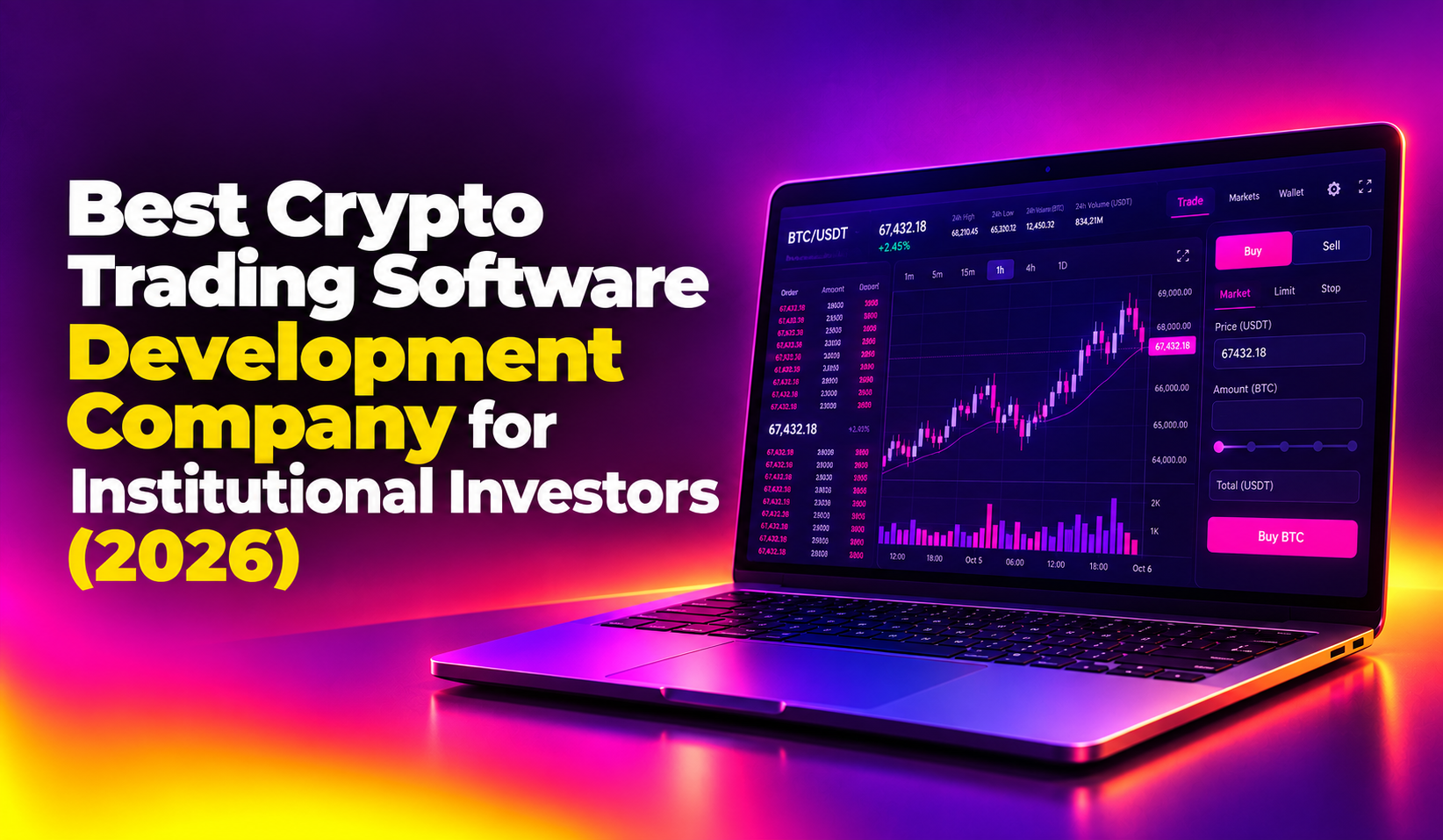
Institutional trading desks and funds moving into digital assets face a hard truth: most crypto software vendors were built for retail apps, not for the security, liquidity, and compliance demands of institutional capital. If you are searching for the best crypto trading software development company for institutional investors, you already know the stakes — a vendor mistake here means custody risk, failed audits, or an execution engine that cannot handle real order flow. This guide breaks down exactly what separates institutional-grade vendors from generic "crypto app builders," how to evaluate them, and why CloudHouse Technologies is built for this exact mandate.
Why Institutional Crypto Trading Software Is a Different Category
Retail crypto apps are optimized for onboarding speed and simple buy/sell flows. Institutional trading infrastructure has to solve for something entirely different: multi-venue liquidity aggregation, sub-second order routing, cold/hot wallet segregation, multi-signature approval workflows, and audit trails that satisfy regulators and internal risk committees simultaneously. A hedge fund or proprietary trading desk cannot afford downtime during volatile markets, and a fund custodian cannot accept a wallet architecture that lacks role-based access controls.
This is why the vendor selection question — who actually builds an institutional crypto trading platform correctly — matters more than which front-end looks the nicest. The underlying engineering (matching engine performance, FIX/REST/WebSocket API design, custody integration, and compliance tooling) determines whether the platform survives contact with real institutional volume.
What "Institutional-Grade" Actually Means in Crypto Trading Software
Execution Speed and Reliability
Institutional desks routinely need high-frequency crypto trading software capable of processing thousands of order events per second with deterministic latency. That requires a matching engine architecture (in-memory order books, event sourcing, horizontally scalable microservices) rather than a monolithic app bolted onto a database.
Liquidity Aggregation
A serious platform doesn't just connect to one exchange — it aggregates order books from multiple venues (Binance, Coinbase Prime, Kraken, OTC desks) via smart order routing, giving the fund best-execution pricing and reducing slippage on large block trades.
Custody and Wallet Security
This is where most generic vendors fail. Institutional custody requires hot/warm/cold wallet segregation, multi-party computation (MPC) or multi-signature approval policies tied to transaction size, and hardware security module (HSM) integration. A vendor without prior custody engineering experience will underestimate this by months.
Compliance and Reporting
KYC/KYB onboarding, AML transaction monitoring, travel rule compliance, and exportable audit logs are not optional add-ons for institutional clients — they are prerequisites for onboarding banks, auditors, and regulators. A secure crypto trading infrastructure bakes compliance into the data model from day one rather than retrofitting it later.
Vendor Comparison: How Development Partners Stack Up
Use this table to benchmark any vendor you're evaluating, including CloudHouse, against the criteria that actually matter for institutional deployments.
| Evaluation Criteria | Generic App Builders | Boutique Blockchain Shops | CloudHouse Technologies |
|---|---|---|---|
| Custody architecture (MPC / multi-sig / HSM) | Rarely offered | Sometimes, inconsistent | Built-in from project kickoff |
| Liquidity aggregation across venues | Single-exchange wrapper | Partial API integrations | Multi-venue smart order routing |
| Compliance tooling (KYC/AML/travel rule) | Bolt-on third party only | Manual/limited | Integrated compliance workflows |
| High-frequency execution capability | Not supported | Limited load testing | Engineered for sub-second order flow |
| Post-launch security audits | Rarely included | One-time only | Ongoing hardening + audit support |
| Dedicated support after go-live | Ticket queue | Limited availability | Direct engineering access |
The pattern is consistent: generic builders optimize for speed-to-market on retail apps, while institutional deployments need security, liquidity, and compliance engineered in from day one. CloudHouse's crypto trading software development team was built specifically to close this gap for funds and trading desks that cannot afford to learn these lessons in production.
Common Mistakes Institutional Buyers Make When Selecting a Vendor
Even sophisticated funds make avoidable errors during vendor selection, and each one tends to surface at the worst possible time — mid-build, during a security audit, or immediately after a large trading volume spike. Recognizing these patterns before you sign a contract can save months of rework.
Treating Custody as a Feature Instead of an Architecture Decision
Many buyers ask vendors "do you support multi-sig wallets?" as a yes/no checkbox question, when the real question is how custody policy is enforced across the entire transaction lifecycle — approval thresholds, time-locks, role segregation, and recovery procedures. A vendor that treats custody as a plug-in module rather than a foundational architecture decision will struggle when your compliance team asks for policy changes post-launch.
Underestimating Liquidity Complexity
Connecting to a single exchange API is trivial. Building smart order routing across multiple venues with real-time best-execution logic, partial fill handling, and failover when a venue goes down is a materially different engineering problem. Buyers who don't ask for a reference architecture here often discover the gap only after go-live, when slippage costs start eating into fund performance.
Ignoring Compliance Until Late in the Build
Retrofitting KYC/AML, travel rule compliance, and audit-exportable reporting into a platform that wasn't designed for it is expensive and often requires re-architecting core data models. Institutional buyers should require compliance mapping as the very first deliverable, not an afterthought scheduled near launch.
Choosing on Price Alone
A lower quote from a generic app builder often excludes custody engineering, liquidity integration depth, and ongoing security audits — all of which get added later as expensive change orders. Institutional buyers should compare fully scoped proposals, not headline numbers.
Technical Architecture Considerations for High-Frequency Institutional Trading
Beyond the checklist items, institutional buyers evaluating high-frequency crypto trading software should dig into a few architectural specifics that separate durable platforms from ones that degrade under load.
- Order book design — in-memory, event-sourced order books scale far better under high-frequency load than database-backed implementations that introduce write contention.
- Horizontal scalability — the matching engine and market data pipeline should scale across nodes without a single point of failure, so a spike in one asset pair doesn't degrade performance platform-wide.
- Latency benchmarking — ask for documented latency figures under simulated load, not just theoretical throughput numbers from a whitepaper.
- Disaster recovery — institutional-grade platforms need documented failover procedures and recovery time objectives (RTOs), especially for custody-related services.
- API design for integration — FIX, REST, and WebSocket APIs need to be documented and stable enough for your internal risk and reporting systems to integrate against without constant rework.
Vendor Evaluation Checklist for Institutional Buyers
- Does the vendor have documented experience building custody workflows (multi-sig, MPC, HSM) — not just wallet UIs?
- Can they show reference architecture for multi-venue liquidity aggregation and smart order routing?
- Do they have in-house compliance engineering experience (KYC/AML/travel rule), or do they outsource it entirely?
- What is their track record with penetration testing and third-party security audits?
- Do they offer post-launch support with defined SLAs, or does support end at deployment?
- Can they provide client references from fintech, exchange, or fund-side deployments — not just generic app portfolios?
- Is their engineering team available for direct technical conversations, or is communication filtered through account managers only?
💡 None of these worked? Skip the guesswork.
Get Expert Help →Building a Custom Crypto Exchange or Trading Desk: What the Process Looks Like
Before any code is written, the vendor should map your jurisdictional compliance requirements, custody model, and expected trading volume against the technical architecture. Skipping this step is the single biggest cause of institutional crypto projects failing mid-build.
The matching engine, order book, and custody layer (hot/warm/cold segregation with MPC or multi-sig policies) are built and stress-tested before any UI work begins. This is the foundation of any credible custom crypto exchange development engagement.
APIs to exchanges, OTC desks, and market makers are integrated with smart order routing logic, and latency is benchmarked under simulated load conditions that mirror real trading volume.
KYC/KYB onboarding, AML transaction monitoring, and audit-exportable reporting are wired into the platform's core data model, not layered on as an afterthought.
Independent security review, penetration testing, and custody policy validation happen before go-live — and should continue on a scheduled cadence afterward.
Post-launch, the vendor should provide defined SLAs for uptime, incident response, and feature iteration as trading volume and regulatory requirements evolve.
Why Institutional Investors Choose CloudHouse for Crypto Trading Software
CloudHouse Technologies builds crypto trading infrastructure with the same engineering discipline institutional investors expect from any core financial system — custody-first architecture, multi-venue liquidity integration, and compliance tooling built into the platform rather than bolted on afterward. Our team works directly with your risk, compliance, and trading stakeholders rather than routing every technical decision through account managers, which shortens the path from requirements to a production-ready platform.
Making the Final Vendor Decision
Once you've shortlisted candidates for the best crypto trading software development company for institutional investors, the final decision usually comes down to three questions: can they show working custody architecture from prior engagements, can their engineering team speak directly to your risk and compliance stakeholders without a communication layer in between, and will they commit to defined support SLAs after go-live. Vendors that hesitate on any of these three should be treated as a risk signal, regardless of how polished their pitch deck looks.
Get a Platform Built for Institutional Requirements, Not Retail Assumptions
If your fund or trading desk needs a partner who understands custody security, liquidity aggregation, and compliance from the first architecture diagram, CloudHouse Technologies is ready to scope your project. Talk to our crypto trading software development team about your institutional requirements and get a technical assessment before you commit to a build.
Frequently Asked Questions
How much does institutional crypto trading software development cost?
Costs vary widely based on scope — a custody-integrated platform with multi-venue liquidity aggregation and compliance tooling typically requires a larger engineering investment than a single-exchange retail app, but pricing depends on your specific volume, jurisdiction, and integration requirements. CloudHouse provides a scoped estimate after an initial technical assessment rather than a generic quote.
How long does it take to build a custom institutional crypto trading platform?
A production-ready platform with custody architecture, liquidity integration, and compliance tooling typically takes several months from requirements mapping through security audit and go-live, depending on the complexity of your custody model and number of liquidity venues integrated.
Can we trust a vendor with our fund's custody architecture and security?
Trust should be verified, not assumed — ask any vendor for documented custody architecture experience, prior security audit results, and references from fintech or exchange-side deployments. CloudHouse builds custody workflows with multi-signature and HSM-backed policies as a core deliverable, not an optional extra, and supports independent security audits before go-live.
Do you offer ongoing support after the platform launches?
Yes — institutional platforms require continuous monitoring, incident response, and iteration as trading volume and regulations evolve. CloudHouse provides defined post-launch support rather than ending the engagement at deployment.
What's the difference between a generic crypto app builder and an institutional-grade development partner?
Generic builders optimize for fast retail app delivery and often lack experience with custody security, multi-venue liquidity aggregation, or compliance engineering. An institutional-grade partner like CloudHouse builds these requirements into the architecture from day one, because retrofitting security and compliance after launch is far more expensive and risky than engineering it in from the start.