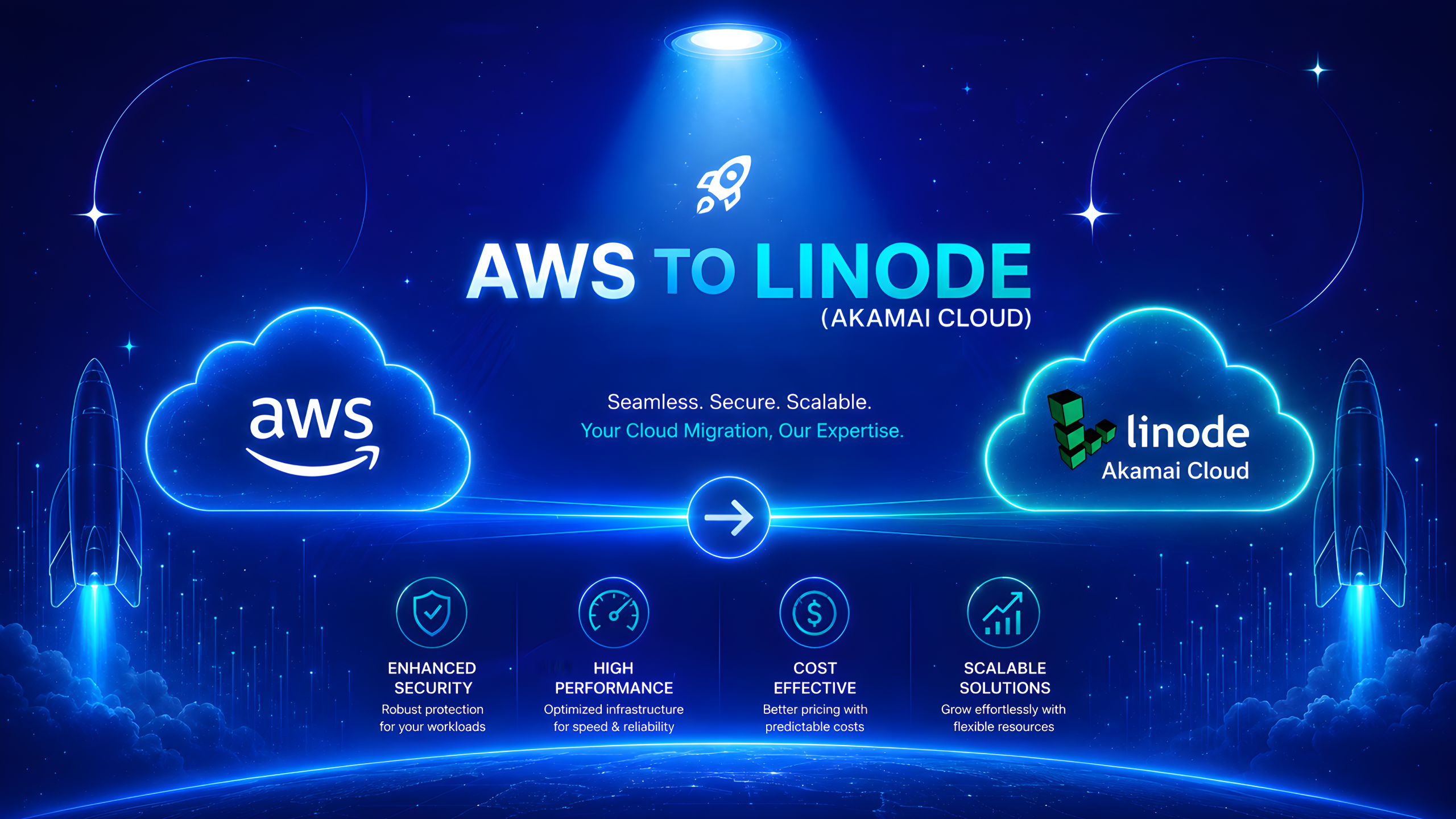
FAXOC Corporation — Cloud Infrastructure Migration
A full re-architecture and migration of a production platform from AWS to Linode (Akamai Cloud), delivering a three-tier private network, automated horizontal a…
Client
FAXOC Corporation
Category
Cloud Hosting & Server Management
Timeline
Multi-phase project
Technologies
12 used
The Problem
FAXOC Corporation's production platform had grown on AWS into a setup that was becoming expensive to run and difficult to scale. All compute ran on EC2 instances with no private network segmentation — every server was reachable from the public internet. There was no connection pooling, so database connections were being exhausted as traffic grew. All production deployments were done manually over SSH, meaning every release required a developer to log in and run commands by hand.
There was no automated capacity management. Scaling up under load required a developer to manually provision a new server, configure it, and add it to the load balancer. The platform had no CI/CD pipeline, no infrastructure-as-code, and no consistent security baseline across its servers.
The goal was not just to move to a cheaper provider — it was to rebuild the platform properly: with network isolation, automated scaling, deployment automation, hardened security, and a clear operational baseline that the team could hand over and maintain.
The Real Cost
Agencies managing 10+ client servers on managed hosting platforms spend $500–$1,000+ per month just for the convenience of not needing a Linux sysadmin. That cost compounds every year, forever.
What We Built
CloudHouse carried out a complete re-architecture of the FAXOC production environment across eight structured phases, rebuilding the entire platform on Linode (Akamai Cloud) in a private three-tier VPC network.
The bastion tier acts as the sole administrative entry point — the only server with a public-facing SSH port, routing all management traffic through a single hardened jump host. The application tier hosts the Django backend API, Celery task workers, the Angular frontend, a FastAPI CV search service, and full staging environments. The data tier runs Elasticsearch, two Redis instances, and RabbitMQ, with no public inbound network rules on any server and the managed PostgreSQL database accessible only from within the private network.
A custom horizontal autoscaling system was built independently for the backend and frontend. New nodes are cloned from golden image snapshots — they come up fully configured, attach to the private network, register with the load balancer, and pass a health check before receiving any traffic. If any provisioning step fails, the node is destroyed and the cluster count rolls back automatically. Scale-up is fast; scale-down is conservative, only removing a node after sustained low CPU to avoid premature capacity loss.
GitLab CI/CD pipelines were built to automate all backend, Celery worker, and frontend deployments. Database migrations always run and complete before Celery workers restart. No secrets are stored in the pipeline — all environment files remain on the servers.
What makes this migration different from a simple lift-and-shift is that CloudHouse re-architected the entire platform while moving it. The client did not just get the same infrastructure on a different cloud — they got a fundamentally better, more secure, and more scalable platform at the end of it.
Everything Included
Every feature you need to manage production servers — no add-ons, no extra charges.
By the Numbers
0 min
Server provisioning time
down from 3+ hours
0
Cloud providers supported
DO, Linode, Vultr, AWS, GCP
0%+
Reduction in support tickets
first quarter post-launch
0 cost
Migration to CloudStick
100% free with full support
The Result
The migration was completed across all 8 phases with every deliverable verified and handed over. 13 production servers are live on Linode (Akamai Cloud).
The platform now has automated horizontal scaling that grows from 1 to 5 nodes per tier based on CPU load, a hardened three-tier private network where no data service has any public inbound access, automated CI/CD deployments that replaced manual SSH releases, managed PostgreSQL with connection pooling to handle database connections as the backend scales, CDN and DDoS protection via Cloudflare, and object storage migrated entirely off AWS.
111 GB of legacy database backup files were cleaned from production disk. The engineering team went from manually deploying over SSH to fully automated pipelines triggered by a git push. Infrastructure changes that previously required manual server provisioning now happen automatically, with safe rollback if anything fails.
Architecture Overview
Project Highlights
Efficient Timeline
Delivered across 8 sequential phases — infrastructure migration, security hardening, DNS migration, backend autoscaling, frontend autoscaling, CDN and email routing, media storage migration, and CI/CD pipeline setup — each phase completed and verified before the next began.
Advanced Technologies
Terraform for infrastructure-as-code provisioning and autoscaling. Django (Gunicorn) + Celery on the backend. Angular frontend served via PM2. FastAPI for CV search. Akamai Managed PostgreSQL with PgBouncer connection pooling on every backend node. Redis, RabbitMQ, and Elasticsearch in an isolated data tier. GitLab CI/CD for automated deployments. Cloudflare for CDN, DDoS protection, and SSL.
Measurable Results
13 production servers migrated with zero production downtime. Manual SSH deployments replaced by automated CI/CD pipelines. Horizontal autoscaling live — 1 to 5 nodes per tier. 111 GB of legacy disk usage eliminated. All 25+ deliverables completed. AWS fully decommissioned.