If you've collected a handful of quotes for your business website in 2026, you've probably seen numbers that don't seem to belong on the same planet — one freelancer quoted $600, an agency quoted $28,000, and a "custom development" proposal came in north of $80,000. You're left wondering which number is fair for what you actually need. Website development cost in 2026 is not a single figure — it's a range driven by a handful of specific factors, and this guide breaks each one down so you can budget with confidence instead of guessing.
What Determines Website Development Cost?
Before comparing quotes, it helps to understand the variables that actually move the price. Two proposals for "a business website" can differ by 10x because they assume completely different scopes.
- Site complexity — a five-page brochure site is a fraction of the work of a multi-role SaaS dashboard or a catalog-driven store.
- Custom design vs. templates — a themed WordPress build is faster and cheaper than a fully custom UI designed from scratch.
- Integrations — CRM sync, payment gateways, ERP connections, and marketing automation each add development and testing hours.
- Content and copywriting — many quotes exclude photography, copywriting, and product data entry, which buyers often underestimate.
- Platform choice — WordPress, Shopify, Webflow, and fully custom (headless/React/Next.js) stacks carry very different licensing and development costs.
- Team structure — a solo freelancer, a boutique agency, and an in-house hire all price their time differently (more on this below).
- Post-launch scope — whether the quote includes QA, cross-browser testing, and a defined revision cycle, or just "delivery."
Because custom website development pricing depends on all of these variables stacking together, the honest answer to "how much does a website cost" is always "it depends on which of the above you need" — which is exactly why a breakdown by site type is more useful than a single average.
It also helps to understand roughly how a typical build budget splits across the actual work. Industry data for 2026 puts web design (research, wireframes, visual design, prototyping) at 30–40% of the total, development (coding, CMS setup, integrations, testing) at 50–60%, and launch and QA (deployment, cross-browser testing, performance tuning) at the remaining 10%. If a quote you've received skips straight from "design" to "done" with nothing allocated to testing or deployment, that's a sign the scope — and the price — may be incomplete.
Website Development Cost Breakdown by Site Type (2026)
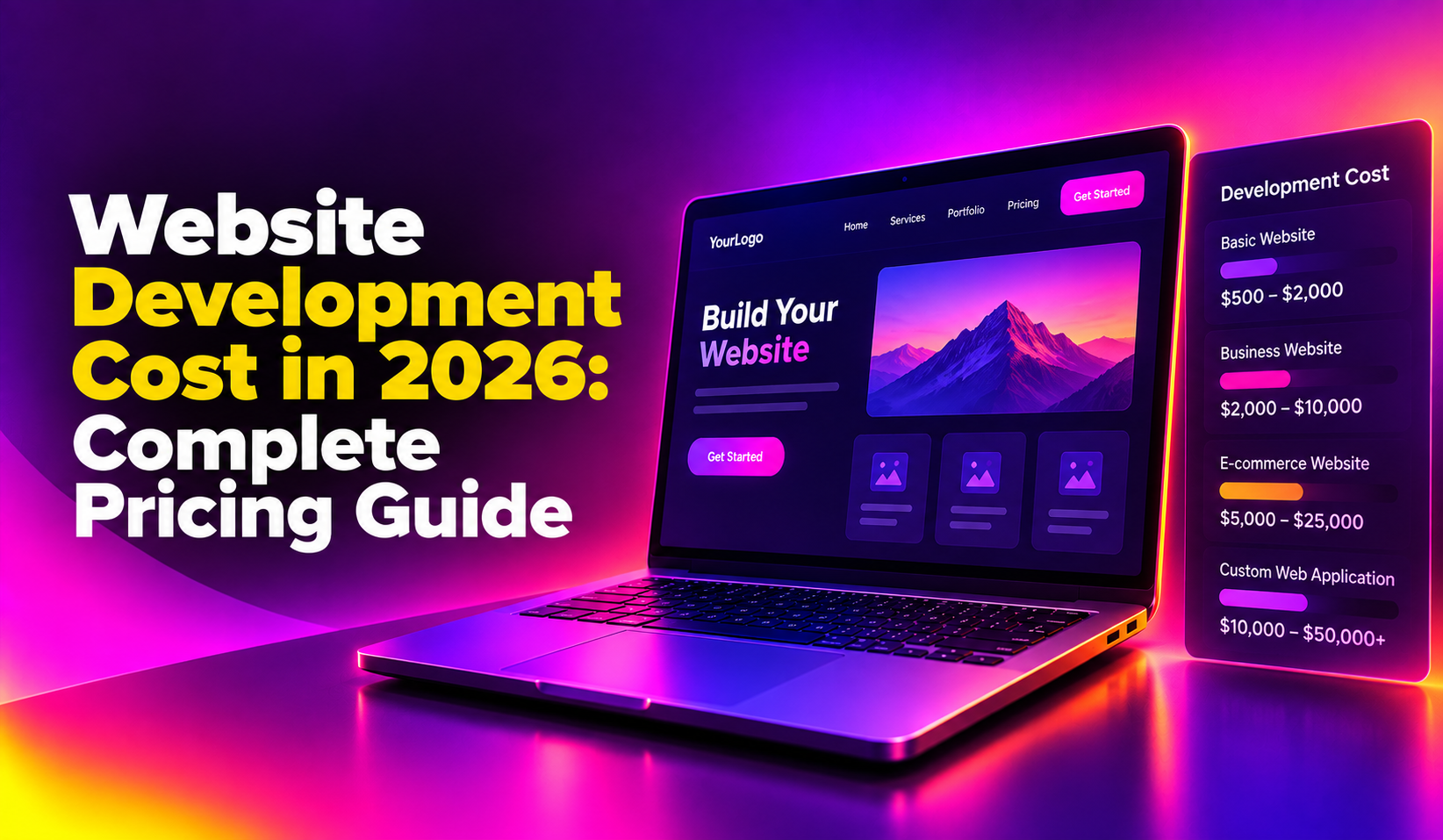
The table below reflects realistic 2026 market ranges gathered from agency rate cards and industry pricing surveys. Use it as a starting point, then adjust for the specific integrations and content volume your project needs.
| Site Type | Typical Cost Range (2026) | What Drives the Range |
|---|---|---|
| Small business brochure site (5–10 pages) | $1,500 – $8,000 | Template vs. custom design, number of pages, copywriting |
| Professional custom site with CMS | $8,000 – $20,000 | Custom UI, blog/CMS setup, on-page SEO, integrations |
| Small–mid ecommerce store | $5,000 – $20,000 | Product count, payment gateway, shipping logic, theme customization |
| Custom / headless ecommerce | $25,000 – $100,000+ | Headless front-end, ERP/inventory sync, custom checkout flows |
| Web application / SaaS MVP | $40,000 – $150,000+ | User roles, payments, dashboards, multi-tenant architecture |
If your project sits toward the higher end because of ERP integration, custom checkout logic, or multi-role dashboards, it's worth speaking to a team that specializes in website development for exactly this kind of scoped, custom build rather than trying to force it into a template.
💡 None of these worked? Skip the guesswork.
Get Expert Help →Hidden Costs to Watch For
The quote you sign is rarely the total cost of owning a website. Most buyer disappointment after launch comes from costs nobody mentioned upfront.
Budget hosting can run $10–$50/month, but performance-tier or managed hosting for ecommerce and high-traffic sites can run $100–$500+/month. Domain renewal is a small annual line item that's easy to forget until it lapses.
CMS platforms need regular plugin, theme, and core updates. Without a maintenance retainer (typically 10–20% of build cost annually), sites accumulate security vulnerabilities and slowly break.
Professional copywriting, photography, and product descriptions are frequently quoted separately — and for ecommerce stores with hundreds of SKUs, data entry alone can cost thousands.
Premium themes, page builder plugins, Shopify apps, and SaaS integrations (email marketing, live chat, analytics) often carry their own monthly fees layered on top of hosting.
Most contracts include a fixed number of revision rounds. Extra design changes or "just one more feature" requests after sign-off are usually billed hourly, and these add up fast if scope wasn't locked down early.
Most reputable agencies split payment into milestones — commonly 30–40% upfront to begin design, 30–40% at development sign-off, and the remainder at launch. Be cautious of vendors demanding 100% upfront, and equally cautious of "pay only at the end" offers on larger custom builds, since neither structure protects both sides if scope or timelines shift midway through the project.
Together, these recurring costs are why the real cost of owning a professionally built website is commonly 100–200% higher over three years than the initial build quote alone. Ask any vendor to itemize these before you sign.
In-House, Freelancer, or Agency: Cost Comparison
Beyond site type, who builds your site changes both the price and the risk profile.
- In-house hire — a full-time developer costs $40,000–$90,000+ annually in salary alone, before benefits and management overhead. Makes sense only if you need continuous, ongoing development, not a single project.
- Freelancer — lower hourly/day rates and fast for simple sites, but availability, quality consistency, and post-launch support vary widely. Good for small brochure sites with limited scope.
- Agency — higher upfront cost but includes project management, QA, design + development under one roof, and defined support after launch — generally the safest option once integrations, ecommerce, or custom features are involved.
For most small businesses and startups budgeting a single project with real functionality requirements — payments, integrations, or a CMS non-technical staff can actually manage — an agency delivers the best cost-to-risk ratio, because you're not gambling the whole project on one person's bandwidth.
There's also a timing risk that rarely shows up in a cost comparison chart: freelancers juggling several clients can stretch a "6-week" project into 4 months, and in-house hires take weeks to onboard before they're productive at all. An agency with a dedicated project manager and a defined delivery process is generally the option least likely to blow both the budget and the calendar at the same time — which matters most if your website launch is tied to a marketing campaign, funding round, or product launch date you can't move.
Why Businesses Choose CloudHouse for Website Development
CloudHouse Technologies scopes every project with a transparent, itemized quote upfront — no vague "starting at" pricing that balloons once integrations get added. Clients get a dedicated team covering design, development, and QA rather than a single freelancer juggling multiple projects, plus post-launch support built into the plan instead of billed as a surprise. Whether you need a lean brochure site or a fully custom ecommerce build with ERP integration, the scoping conversation happens before any commitment, not after.
Frequently Asked Questions
Why do website quotes vary so much between vendors?
Quotes vary because vendors assume different scopes by default — one may include only design, another may include full development, QA, and a content migration. Platform choice (template vs. custom code), the number of integrations, and whether copywriting and photography are included all shift the number significantly. Always ask for an itemized breakdown before comparing two quotes side by side.
Are there hidden costs after the site launches?
Yes — hosting, domain renewal, security patches, plugin/theme licenses, and ongoing maintenance are the most commonly missed costs. A realistic budget should assume recurring annual costs of roughly 10–20% of the build price for maintenance alone, plus hosting fees that scale with traffic and features.
How much does a business website cost in India specifically?
In India, a small business website with a professional design typically runs ₹40,000–₹1,50,000 (roughly $500–$1,800), while custom-built sites with CMS and integrations range from ₹1,50,000–₹6,00,000+. Ecommerce builds with payment gateway integration and inventory management usually start around ₹2,00,000 and scale up with catalog size and customization.
Is it cheaper to build an ecommerce site on Shopify or go fully custom?
Shopify and similar hosted platforms are almost always cheaper upfront — a solid Shopify store typically costs $5,000–$20,000 versus $25,000–$100,000+ for a fully custom or headless build. Custom development only pays off when you need checkout logic, integrations, or scale that hosted platforms genuinely can't support.
How long does it take to build a website, and does a faster timeline cost more?
A brochure site typically takes 3–6 weeks, a custom CMS site 6–10 weeks, and an ecommerce or web application build 10–20+ weeks depending on integrations. Rushed timelines usually do cost more, since they require additional developers working in parallel rather than a single sequential build — factor this in if you have a hard launch date.
Getting a fair price starts with a clear scope, not a guessed number. If you're ready to see what your specific project should actually cost, talk to CloudHouse Technologies about your website development project and get an itemized quote before you commit to anything.