If you've requested three quotes for a server migration project, you've probably gotten three wildly different numbers — and no clear explanation of why. One provider quotes $800, another quotes $6,000, and a third wants an hourly retainer with no cap. This server migration cost 2026 guide breaks down exactly what a fair price includes, what drives Linux vs Windows pricing apart, and how to budget for a zero-downtime move without getting burned by hidden fees.
What Is Server Migration and Who Needs It?
Server migration is the process of moving your applications, databases, files, and configurations from one server or hosting environment to another — whether that's an old dedicated box to a new one, one data center to another, or a legacy on-prem server to a cloud VPS. It covers everything from DNS cutover and data transfer to service reconfiguration, security hardening, and post-migration testing.
Businesses typically need a migration when: their current host is being decommissioned, their contract or lease is ending, they've outgrown their current server's resources, they're consolidating multiple servers into one, or they're moving from an aging Windows Server version that's approaching end-of-life. IT managers and founders comparing vendor quotes are usually in one of these situations and need to know, in plain numbers, what a competent migration actually costs.
💡 None of these worked? Skip the guesswork.
Get Expert Help →How Much Does Server Migration Cost in 2026?
Pricing for server migration service pricing in 2026 generally falls into three models: flat-fee per server, hourly/time-and-materials, and project-based (for multi-server or complex environments). Here's what each typically includes and costs.
| Migration Type | Typical Price Range (2026) | What's Usually Included |
|---|---|---|
| Single Linux server (cPanel/WHM, DirectAdmin, Plesk) | $250 – $900 | Full account/data transfer, DNS cutover, email migration, basic testing |
| Linux server migration pricing — multi-server / clustered | $900 – $3,500 per server | Load balancer reconfiguration, database replication, staged cutover, rollback plan |
| Single Windows Server (IIS, SQL Server, Active Directory) | $600 – $2,000 | Role/feature migration, licensing revalidation, AD/DNS sync, application testing |
| Windows server migration cost — SQL Server + AD environment | $2,000 – $7,000 | Database migration, domain controller sync, downtime scheduling, licensing compliance check |
| Zero downtime migration cost add-on (any OS) | +$500 – $3,000 | Parallel-run environment, live replication, staged DNS TTL reduction, extended monitoring window, rollback rehearsal |
| Hourly / ad-hoc support (no fixed scope) | $35 – $90 / hour | Billed only for actual work performed — best for small or undefined-scope jobs |
Windows migrations tend to cost 20–40% more than equivalent Linux jobs. The reason isn't complexity alone — it's licensing. Linux distributions are free, but Windows Server, SQL Server, and any bundled software require licensing revalidation on the new hardware, and providers must account for per-core Microsoft licensing costs that can add $11–$60/month depending on edition and core count. If a quote for a Windows migration looks suspiciously close to a Linux quote, ask directly whether licensing compliance was actually checked.
What Drives the Price Up (Hidden Fees to Watch For)
- Data volume and egress fees: transferring terabytes of data, especially across cloud providers, can incur egress charges the "migration fee" doesn't cover.
- DNS cutover complexity: multi-domain setups, custom mail routing, or third-party CDN configs add hours.
- Testing and validation: a quote that skips a dedicated testing phase is a quote that skips catching problems before your customers do.
- Rollback planning: if a provider can't tell you what happens if the migration fails halfway, they haven't priced in a rollback plan — and you're exposed.
- After-hours or weekend cutover windows: some providers charge a premium for scheduling the cutover outside business hours to minimize customer impact.
A genuinely fair quote should itemize data transfer, DNS cutover, testing, and rollback as line items — not bury them as "additional work" discovered mid-project.
What a Fair Migration Timeline Actually Looks Like
Part of what makes vendor quotes hard to compare is that "server migration" can mean a two-hour job or a two-week project depending on scope. A transparent provider will walk you through the phases before quoting a number, not after:
The provider reviews your current server configuration, installed software, databases, cron jobs, firewall rules, and DNS records to build an accurate inventory of what needs to move. Skipping this step is the single biggest cause of post-migration surprises — missed cron jobs, forgotten SSL certificates, or firewall rules that don't get replicated.
The new server is provisioned and configured to mirror the old one as closely as possible — same OS version, same control panel (cPanel, Plesk, DirectAdmin, or Webmin), same PHP/database versions where applicable — before any live data moves.
Files, databases, and email are transferred, usually in an initial bulk copy followed by a final delta sync immediately before cutover to capture any changes made during the transfer window.
DNS TTLs are lowered ahead of time so the cutover propagates quickly, then A records and MX records are updated to point at the new server. This is the step most likely to cause visible downtime if not planned properly.
The new environment is tested for functionality — website loads, forms submit, email delivers, database queries return correct data — before the old server is decommissioned.
A monitoring window (typically 48–72 hours, sometimes up to two weeks for enterprise environments) is kept in place to catch any issues that only surface under real production traffic, with the old server kept on standby for rollback if needed.
A quote that doesn't account for all six phases is a quote that's likely to expand mid-project — which is exactly how a $600 estimate turns into a $2,500 invoice.
What to Look for in a Server Migration Provider
Since most quotes buyers receive are vague on scope, use this checklist when comparing providers:
- Does the quote explicitly list data transfer, DNS/TTL management, and post-migration testing as separate line items?
- Is there a documented rollback plan in case the migration fails or introduces regressions?
- Does the provider guarantee a maximum downtime window, or only a "best effort"?
- Do they support both Linux and Windows environments, or are you locked into a single-OS specialist even if your stack is mixed?
- Is post-migration support included for a set period (e.g. 7–14 days) to catch issues that only show up under real traffic?
- Are they transparent about per-hour overage rates if the scope expands mid-project?
Providers offering a proper server migration service should be able to answer every one of these questions in the sales conversation, not after you've signed a contract.
In-House vs Outsourced Migration: Which Is Right for You?
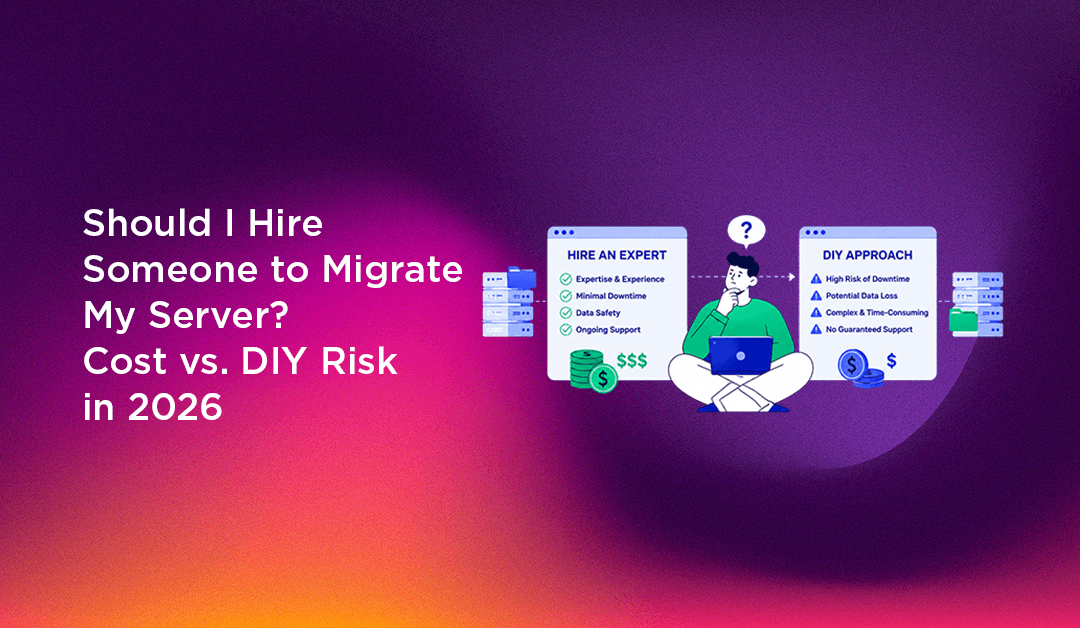
Some IT teams consider handling migration internally to save on vendor fees. It can work — if you already have staff experienced in DNS cutover, database replication, and rollback procedures, and if you can absorb the risk of an in-house team encountering an unfamiliar edge case mid-cutover.
For most businesses, especially those without a dedicated systems administrator, outsourcing is cheaper in practice once you account for the value of staff time diverted from other work, and the cost of an extended outage if something goes wrong. A specialist who has run dozens of migrations will catch DNS propagation issues, permission mismatches, and licensing gaps that an in-house generalist may not anticipate until it causes downtime.
The break-even point is roughly this: if your migration involves more than one server, any database replication, or a hard requirement for zero downtime, outsourcing to a specialist typically costs less overall than the risk-adjusted cost of doing it in-house for the first time.
Why Hosting Companies Choose CloudHouse for Server Migration
CloudHouse handles both Linux and Windows migrations under one roof, with transparent per-server or hourly pricing and no vague "it depends" quoting. Every migration includes a documented rollback plan, staged DNS cutover to minimize propagation risk, and a post-migration monitoring window — so hosting companies and IT teams get predictable costs instead of surprise invoices. Our team bills hourly with no long-term lock-in, which means you pay for the work done, not a padded retainer.
Ready to Get a Straight Answer on Your Migration Cost?
If you've been stuck comparing vague quotes, get a real, itemized price instead. Request a free server migration quote from CloudHouse Technologies and find out exactly what your move will cost — data transfer, DNS cutover, testing, and rollback plan included, with no hidden extras.
Frequently Asked Questions
Is the quoted price the final price, or should I expect extra charges later?
With a properly scoped quote, the quoted price should be final for the agreed scope. Extra charges typically only apply if you request additional work mid-project (e.g. adding a server, expanding the data set, or extending the testing window). Always ask upfront whether data transfer, DNS cutover, and testing are included in the base price or billed separately — that's where most "surprise" invoices come from.
What happens if the migration fails halfway through?
A competent provider will have a documented rollback plan before the migration starts — meaning your original server stays untouched and live until the new environment is fully tested and verified. If something fails mid-cutover, DNS and traffic simply route back to the original server with minimal disruption. Never proceed with a provider who can't describe their rollback process in specific technical terms.
How much does server migration cost for a small business?
A single Linux server migration for a small business typically costs $250–$900, while a single Windows Server migration runs $600–$2,000 due to licensing revalidation. Multi-server or zero-downtime requirements push costs higher — see the pricing table above for a full breakdown by scenario.
How long does a typical server migration take?
A single-server migration with standard downtime usually completes in 4–12 hours, including testing. Zero-downtime migrations take longer to prepare (often 3–5 days of staged replication and DNS TTL reduction beforehand) but the actual cutover itself can be near-instantaneous. Multi-server or database-heavy migrations can take several days depending on data volume.
Do I need to pay extra for zero-downtime migration, and is it worth it?
Yes — zero downtime typically adds $500–$3,000 depending on complexity, covering parallel-run infrastructure, live data replication, and extended monitoring. It's worth it if an hour of downtime would cost your business more in lost revenue, SLA penalties, or reputation damage than the add-on fee itself — which is the case for most e-commerce sites, SaaS platforms, and client-facing hosting environments.