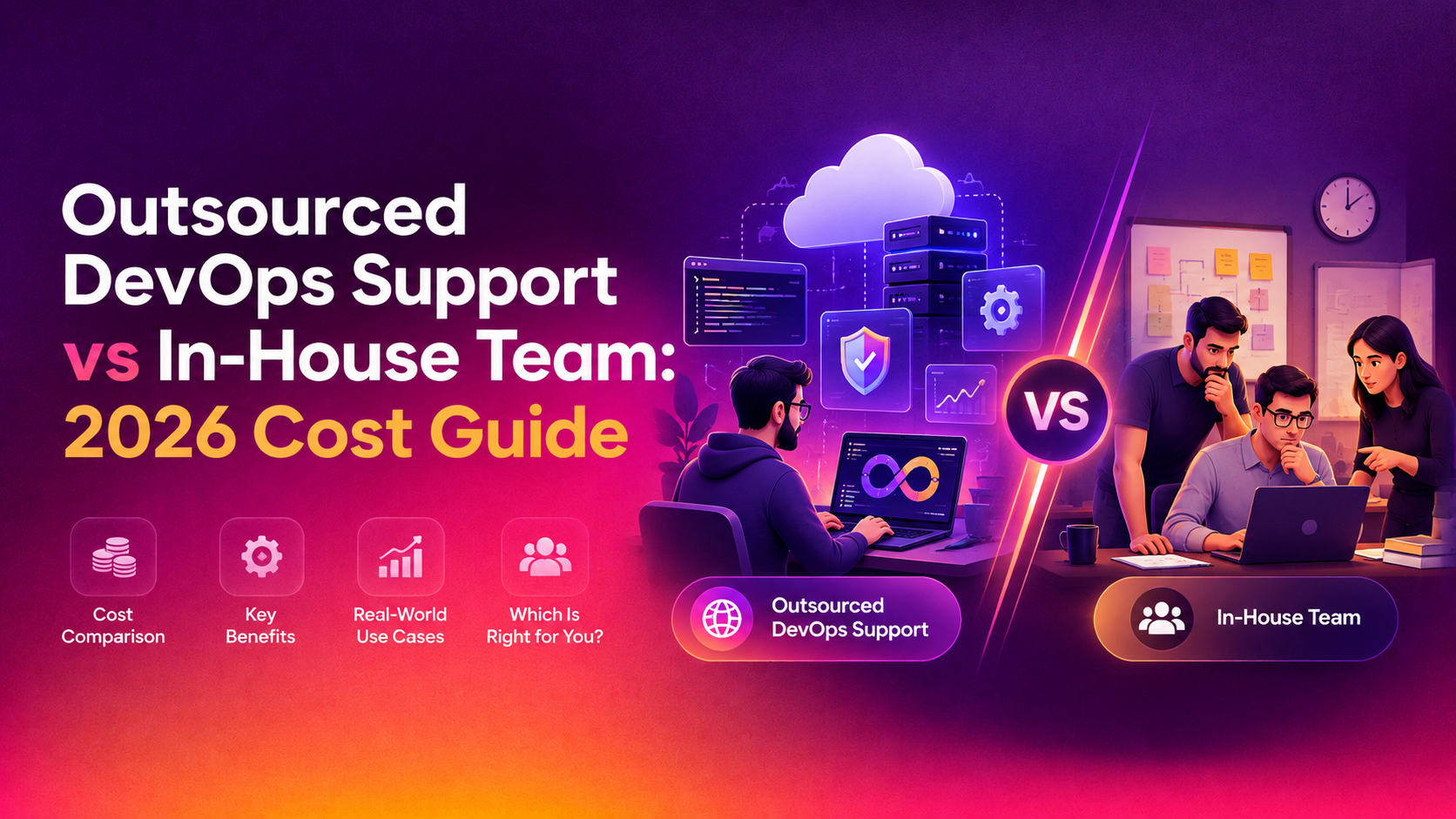
If you're weighing outsourced DevOps support vs an in-house team, you're probably staring at two numbers that don't feel real: a six-figure annual salary bill on one side, and a monthly retainer that seems too good to be true on the other. You're not wrong to be skeptical. This guide breaks down the real 2026 costs, hiring timelines, and hidden risks of both paths so you can make a decision based on numbers, not vendor sales pitches.
What Does DevOps Support Actually Cover?
Before comparing costs, it helps to be clear on what "DevOps support" actually means day-to-day. A competent DevOps function — whether it's one in-house engineer or an outsourced team — is responsible for:
- CI/CD pipeline management — building and maintaining automated build, test, and deployment pipelines
- Infrastructure as Code (IaC) — Terraform, Ansible, or CloudFormation scripts that keep environments reproducible
- Container orchestration — Docker and Kubernetes cluster management, scaling, and upgrades
- Monitoring and alerting — observability stacks (logs, metrics, traces) with on-call incident response
- Cloud cost optimization — right-sizing instances, reserved capacity, and FinOps reviews
- Security and compliance — patching, secrets management, and audit trails for standards like SOC2, PCI DSS, or HIPAA
That's a wide surface area to cover, which is exactly why the "one generalist engineer" approach so often falls short — and why the in-house vs outsourced decision matters more than it looks on paper.
In-House DevOps: The Real Cost and Timeline
The advertised salary for a DevOps engineer is only part of the true cost. A fully loaded in-house DevOps hire includes base salary, benefits, payroll taxes, recruiting fees, onboarding time, tooling licenses, and ongoing training. Industry benchmarking in 2026 puts a realistic in-house DevOps team (two to three engineers plus a lead) at roughly $640,000 to $960,000 per year in North America and Western Europe — and that's before accounting for turnover.
The timeline is the part most founders underestimate. Sourcing, interviewing, and onboarding a qualified DevOps engineer typically takes six to twelve months in a competitive market, especially for specialized skills like Kubernetes security or multi-cloud governance. During that window, deployments stay slow, incidents get handled reactively, and technical debt compounds.
There's also a coverage gap that's easy to miss: a single in-house engineer cannot deliver true 24/7 coverage. To get around-the-clock monitoring and incident response with only in-house staff, most companies need five or more engineers in rotation — which pushes the real cost even higher for anything beyond business-hours support.
Outsourced DevOps Support: What It Costs in 2026
Outsourced and managed DevOps support is typically priced one of three ways:
- Hourly billing — ranging from roughly $35/hour for offshore talent to $200+/hour for onshore senior consultants
- Flat monthly retainer — the most common model for ongoing support, typically $2,999 to $15,000/month depending on infrastructure size and coverage level
- Hybrid — a fixed retainer plus a percentage (5–15%) of managed cloud spend, common for cost-optimization-heavy engagements
What changes the price most isn't headcount — it's coverage level. Business-hours support (Monday–Friday) sits at the low end. True 24/7 on-call coverage with defined SLAs (for example, P1 incidents acknowledged within 15 minutes) costs more, but it's still dramatically cheaper than staffing an in-house rotation to match it. Specialized work — Kubernetes security hardening, AIOps-driven monitoring, multi-cloud governance — typically commands a 20–30% premium over general DevOps retainers.
Compare that to the in-house numbers above: outsourcing typically runs $96,000 to $240,000 per year for equivalent coverage — a 30-50% saving — and a working team is in place within days, not months.
Side-by-Side Comparison Table
| Factor | In-House DevOps Team | Outsourced DevOps Support |
|---|---|---|
| Annual cost (typical) | $640,000 – $960,000 | $96,000 – $240,000 |
| Time to fully staffed | 6 – 12 months | Days to 2 weeks |
| 24/7 coverage | Requires 5+ engineers | Included in most managed plans |
| Skill breadth | Limited to hires made | Access to a full specialist bench |
| Scalability | Slow — requires new hiring cycles | Flexible — scale hours up/down monthly |
| Turnover risk | High — single points of failure | Low — team-based redundancy |
| Institutional knowledge | Fully retained in-house | Retained via documentation & handover process |
Common Objections to Outsourcing (and the Truth)
"We'll lose control of our infrastructure." A well-run outsourced engagement uses the same IaC, version control, and change-approval workflows your in-house team would use — you retain full visibility and ownership of every Terraform file, pipeline config, and access log. Nothing is a black box.
"It's cheaper to just hire someone eventually." "Eventually" is the problem. Every month without proper DevOps support means slower releases, unplanned downtime, and manual toil that costs engineering hours elsewhere. The real comparison isn't "outsourced cost vs in-house cost" — it's "outsourced cost now vs six months of nothing plus in-house cost later."
"A third party won't understand our stack as well." This is a fair concern with generalist agencies, but a specialized DevOps support partner runs a structured onboarding audit of your existing infrastructure before taking over anything — the same ramp-up any new in-house hire would need, minus the recruiting delay.
A popular middle ground is the hybrid model: keep one or two platform engineers in-house who own architecture decisions and product context, while an outsourced partner handles day-to-day operations — monitoring, deployments, patching, and incident response. You keep institutional direction at a fraction of a fully in-house cost.
How to Choose the Right DevOps Support Partner
Not all outsourced DevOps providers are equal. Before signing anything, verify the provider covers these non-negotiables:
- Multi-factor authentication and least-privilege access across all pipeline and infrastructure accounts
- Automated security scanning — SAST, dependency/SCA scanning, and secrets detection built into CI/CD
- Defined incident response SLAs — know exactly how fast a P1 outage gets acknowledged and by whom
- Full audit logging for every infrastructure change, for compliance and post-incident review
- Transparent, documented infrastructure — you should own the Terraform/IaC repos, not the vendor
- A clear offboarding/handover clause — you should never be locked in if the relationship ends
- Compliance experience relevant to your industry (SOC2, PCI DSS, HIPAA, GDPR, as applicable)
Ask any candidate provider to walk you through a real onboarding audit process and a recent incident postmortem — vague answers here are a red flag.
Why Hosting Companies and Growing Teams Choose CloudHouse for DevOps Support
CloudHouse Technologies runs DevOps support engagements on flexible hourly and monthly-retainer terms with no long-term lock-in, giving teams full ownership of their infrastructure code and 24/7 incident response without the 6-12 month hiring cycle a first in-house hire requires. Clients get a named engineering contact, documented runbooks from day one, and pricing that scales with actual infrastructure size rather than a flat enterprise rate card.
Frequently Asked Questions
How much does outsourced DevOps support cost per month?
Most managed DevOps retainers in 2026 range from $2,999 to $15,000 per month depending on infrastructure size, number of environments, and whether you need business-hours or full 24/7 on-call coverage. Hourly engagements typically run $35-$200+/hour based on seniority and specialization.
Is outsourced DevOps support cheaper than hiring in-house?
Yes, in most cases. A fully loaded in-house DevOps team costs roughly $640,000-$960,000/year, versus $96,000-$240,000/year for an equivalent outsourced arrangement — a 30-50% saving, with the team operational in days rather than months.
How long does it take to onboard an outsourced DevOps provider?
A structured onboarding audit and handover typically takes one to two weeks, compared to six to twelve months to source, interview, and onboard a qualified in-house DevOps engineer in a competitive market.
Will we lose visibility or control over our infrastructure if we outsource?
No, provided the provider uses standard Infrastructure-as-Code practices. You should always retain ownership of your Terraform/IaC repositories, access logs, and pipeline configurations regardless of who operates them day-to-day.
Can we switch from outsourced DevOps support back to an in-house team later?
Yes. A properly structured engagement includes a documented handover clause and up-to-date runbooks, so you can transition to an in-house team (or a hybrid model) at any point without losing institutional knowledge.