Every year, more attackers automate scans for exposed SSH ports, default database credentials, and unpatched services — and a single misconfigured production server can turn into a data breach, a compliance failure, or a customer-facing outage overnight. That is exactly why so many hosting companies, SaaS teams, and growing SMBs stop trying to harden servers themselves and start asking a much more practical question: how to choose a server hardening provider that will actually reduce risk instead of just selling a checklist and disappearing.
This guide breaks down what a real server hardening company should deliver, what the service typically costs in 2026, the seven things you must verify before signing a contract, and a side-by-side checklist you can use in your own vendor evaluation calls. If you're comparing quotes right now, this is the framework to use before you commit budget.
What Does a Server Hardening Provider Actually Do?
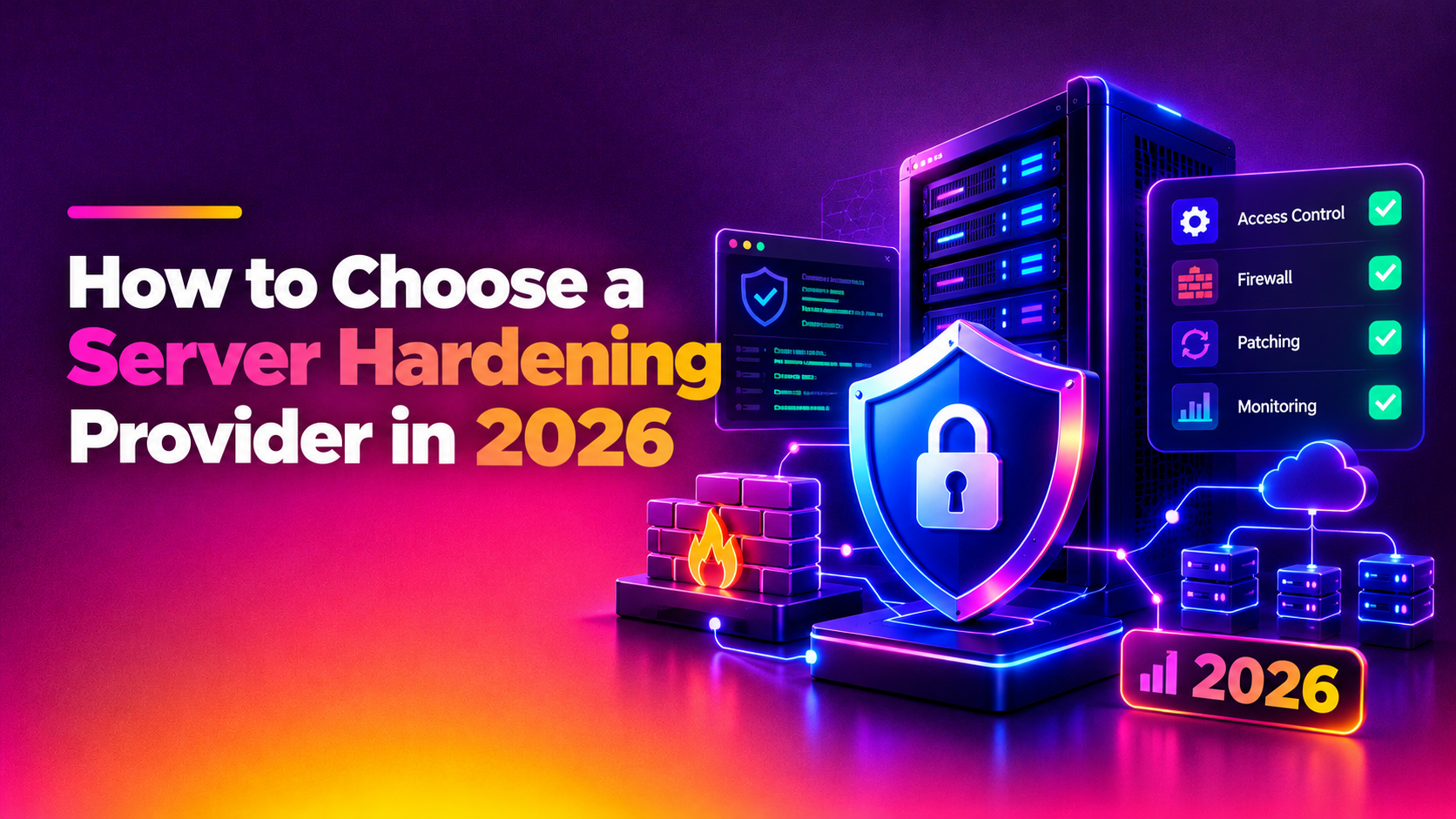
A server hardening company doesn't just install a firewall and call it done. A competent managed server hardening engagement covers the full attack surface of a production server: the operating system, the network stack, the applications running on top, and the access controls that govern who can touch any of it.
In practice, that means:
- Disabling unused services, ports, and daemons that increase the attack surface for no operational benefit
- Enforcing SSH key-based authentication, disabling root login, and rotating credentials
- Deploying and tuning a host-based firewall (CSF, iptables, firewalld, or UFW depending on the stack)
- Configuring intrusion detection and brute-force protection (fail2ban, OSSEC, or equivalent)
- Patch management — applying kernel and package security updates on a defined cadence without breaking production
- File integrity monitoring and audit logging so any unauthorized change is caught, not discovered three months later
- Hardening web server and database configurations (disabling directory listing, restricting default ports, enforcing TLS 1.2+)
- Documentation and compliance evidence — the paperwork that proves the work was actually done, for auditors, cyber insurance, or enterprise customers
The difference between a real provider and a "run one script and invoice you" vendor is that the former treats hardening as an ongoing service — a server that was hardened once and never revisited is, within a year, no more secure than one that was never touched at all. If you want to see what a full server hardening service looks like when it's built around continuous monitoring rather than a one-time sweep, that's the baseline to compare every quote against.
How Much Does Server Hardening Cost in 2026?
Pricing for server hardening service cost varies more than most buyers expect, mostly because "hardening" means different things to different vendors. In 2026, most legitimate providers price around three models:
- One-time hardening audit + remediation: typically $150–$600 per server, depending on OS complexity, number of installed applications, and whether compliance documentation (PCI-DSS, HIPAA, SOC 2) is required.
- Ongoing managed hardening (monthly retainer): commonly $40–$250 per server per month, bundled with patch management, monitoring, and incident response. This is the model most hosting companies and agencies with 10+ servers actually choose, because a single point-in-time fix goes stale within weeks.
- Enterprise/compliance-driven contracts: $500–$2,000+ per month per server cluster when PCI, HIPAA, or SOC 2 evidence packages, quarterly penetration testing, and 24/7 SOC monitoring are bundled in.
Two cost traps to watch for. First, a suspiciously cheap flat fee that only covers a "hardening script" run once — you'll be back in the market for a vendor within six months when the server drifts out of compliance. Second, vague scoping: always get a written list of exactly which controls (SSH, firewall, IDS, patching cadence, logging) are included before comparing two quotes side by side, because a $99/month plan and a $199/month plan covering the same five controls are not equivalent if one skips patch management entirely.
💡 None of these worked? Skip the guesswork.
Get Expert Help →7 Things to Check Before Hiring a Server Hardening Company
Before you sign anything, run every candidate vendor through this list. Most of the vendor-selection guides that rank for this topic stop at generic advice like "check reviews" — here's what actually separates a dependable server hardening company from a risky one:
A real provider can show you an anonymized before/after audit from a past client — CIS benchmark scores, open ports closed, services disabled. If they can't produce one, they likely don't have a repeatable process.
Look for alignment with CIS Benchmarks, NIST 800-53, or vendor-specific hardening guides (e.g., cPanel/WHM, Plesk, or cloud provider baselines). A provider working from an internal, undocumented checklist is harder to audit and harder to hold accountable.
Ask explicitly: "What happens when a critical CVE drops next month?" If the answer isn't a defined SLA for emergency patching, the hardening will decay within weeks.
If you need PCI-DSS, HIPAA, or SOC 2 evidence, ask exactly what documentation they generate and how often. Vague promises of "we're compliant" without exportable reports is a red flag — auditors don't accept verbal assurances.
Hardening touches production systems. A competent provider tests changes in a maintenance window, keeps configuration backups, and has a documented rollback plan if a firewall rule or service change breaks something unexpected.
If an intrusion attempt is detected at 2 a.m., what's the guaranteed response time? "Best effort" is not an SLA. Look for a written commitment — ideally under an hour for critical alerts.
Hosting companies and agencies often add or retire servers monthly. Make sure the pricing model (per-server, tiered, or hourly) doesn't lock you into paying for decommissioned infrastructure.
In-House vs Outsourced Server Hardening: Which Wins?
Some IT teams still ask whether it's cheaper to just hire an in-house engineer to handle hardening rather than pay an outsourced server security hardening provider. The honest answer depends on how many servers you run and how specialized the workload is.
| Factor | In-House Hardening | Outsourced Provider |
|---|---|---|
| Upfront cost | High — full-time security engineer salary ($70k–$130k/yr) | Low — pay per server or per retainer, starts at ~$40/month |
| Coverage | Limited to business hours unless you build a 24/7 rotation | 24/7 monitoring is standard with most managed providers |
| Expertise breadth | One person's knowledge of CIS benchmarks, compliance frameworks, and emerging CVEs | Access to a team that hardens dozens of environments and sees new attack patterns faster |
| Scalability | Adding servers means adding headcount | Scales with your infrastructure, billed per server |
| Compliance documentation | You build the audit trail yourself | Providers often include ready-made compliance evidence packages |
| Best fit | Large enterprises with 100+ servers and dedicated security budget | Hosting companies, SMBs, and agencies with 1-50 servers |
For most businesses under 50 servers, outsourcing wins on cost and coverage — a single in-house hire simply can't match 24/7 monitoring and a team's accumulated pattern recognition across hundreds of hardened environments.
Comparison Checklist: Evaluating Server Hardening Vendors
Use this as a literal checklist on your next three vendor calls:
- ☐ Do they provide a written scope listing every control included (SSH, firewall, IDS, patching, logging, monitoring)?
- ☐ Do they follow CIS Benchmarks or an equivalent recognized standard?
- ☐ Is patch management included on an ongoing basis, not a one-time fix?
- ☐ Can they produce compliance evidence reports (PCI-DSS, HIPAA, SOC 2) if you need them?
- ☐ Do they have a documented rollback plan for changes made during a maintenance window?
- ☐ Is there a written incident response SLA (response time for detected intrusions)?
- ☐ Is pricing transparent and does it scale cleanly as you add or remove servers?
- ☐ Can you talk to an existing client or see an anonymized sample report?
If a vendor can't check every box above in a single sales call, that's a signal to keep shopping — not a reason to lower your standards.
Why Hosting Companies and SMBs Choose CloudHouse for Server Hardening
CloudHouse Technologies runs server hardening as an ongoing managed service rather than a one-off script: CIS-aligned configuration, continuous patch management, 24/7 monitoring, and exportable compliance reports are included by default, not sold as add-ons. Billing is transparent and scales per server, so hosting companies adding or retiring infrastructure monthly never pay for decommissioned boxes. Most engagements start with a free security audit so you can see exactly what's exposed before committing to anything.
Frequently Asked Questions
How much does server hardening cost per server per month?
Ongoing managed server hardening typically runs $40–$250 per server per month depending on the number of controls included (firewall, IDS, patch management, compliance reporting) and whether 24/7 monitoring is bundled in. One-time audits without ongoing management usually cost $150–$600 per server.
How long does it take to harden a production server?
An initial hardening pass on a single production server usually takes 2–5 business days, including a discovery audit, a scheduled maintenance window for changes, and a validation pass to confirm nothing broke. Ongoing hardening (patching, monitoring, log review) then runs continuously in the background with no additional downtime.
Is server hardening a one-time service or ongoing?
It should be ongoing. A server hardened once and never revisited drifts out of a secure state within weeks as new CVEs are disclosed, packages update, and configurations change. Any provider selling hardening as a single fixed-fee, no-followup service is not actually reducing your long-term risk.
Can I trust a server hardening provider with compliance requirements like PCI-DSS or HIPAA?
Yes, but verify first — ask for a sample compliance evidence report before signing. A trustworthy provider can show exportable audit logs, CIS benchmark scores, and documented control mappings to the specific framework you need, rather than a verbal assurance that "we're compliant."
What's the difference between server hardening and a firewall or antivirus?
A firewall and antivirus are perimeter and signature-based defenses. Server hardening reduces the underlying attack surface itself — closing unused ports, disabling unnecessary services, enforcing strong authentication, and locking down configurations — so that even if an attacker gets past the perimeter, there's far less to exploit on the server itself.
Choosing the wrong server hardening provider costs more than a bad monthly invoice — it costs you the false confidence that your servers are protected when they aren't. Use the checklist above on your next vendor call, and if you'd rather skip the vetting process entirely, get a free CloudHouse server hardening audit and see exactly where your exposure is today.