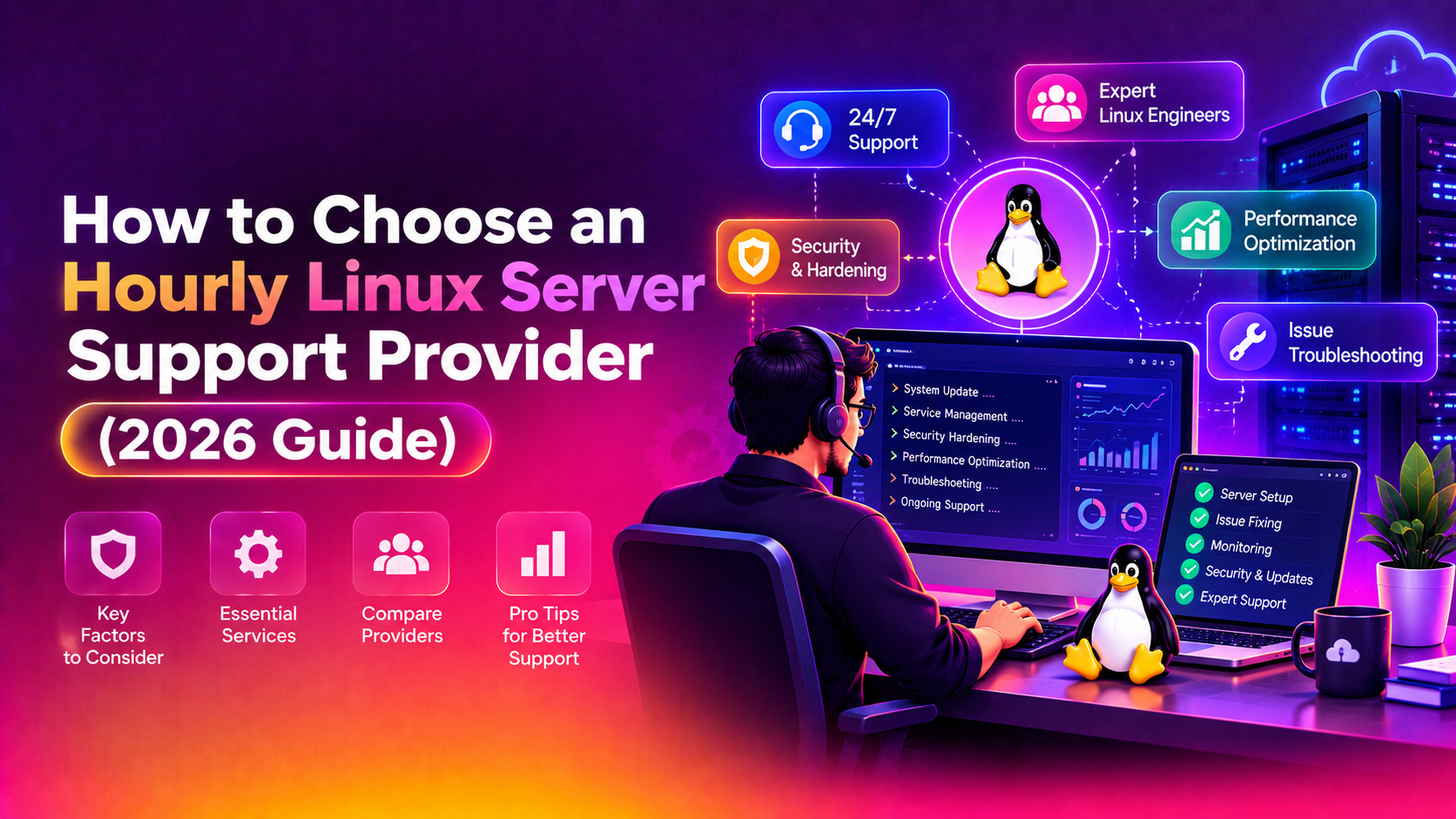
If you've ever hired a Linux freelancer who took six hours to reply to a "the server is down" message, you already know that not all hourly Linux server support is the same. Learning how to choose hourly Linux server support that actually delivers on response time, real expertise, and honest billing is the difference between a partner you keep for years and another vendor you have to fire in month two. This guide gives you the exact criteria, the interview questions, and the red flags to check before you commit to a provider.
What Is Hourly Linux Server Support?
Hourly Linux server support is an on-demand engineering arrangement where you pay only for the time a qualified sysadmin or DevOps engineer actually spends working on your server — troubleshooting downtime, patching security holes, tuning performance, or handling migrations — instead of committing to a full-time hire or a rigid monthly retainer. It's built for small businesses, agencies, and startups that need occasional, expert-level Linux help but don't have (or want) the budget for a full-time systems administrator.
The appeal is obvious: no salary, no benefits, no idle hours. The risk is just as real — because you're trusting a stranger with root access to production infrastructure, and the wrong hire can turn a two-hour fix into a two-day outage.
The market for this kind of support ranges widely: overseas freelance marketplaces, boutique regional shops, and dedicated managed-service providers all use the phrase "hourly Linux support," but they mean very different things by it. A freelancer might genuinely be skilled but have zero backup coverage. A large managed-hosting company might have excellent SLAs but bury you in tiered support contracts you don't need. The right fit depends on matching your actual ticket volume and risk tolerance to a provider's structure — not just picking whoever quotes the lowest hourly rate.
Key Criteria for Choosing a Provider
Before you sign anything, run every candidate provider through the same checklist. Consistency here is what separates a rigorous vetting process from a coin flip.
| Criterion | Why It Matters | Questions to Ask |
|---|---|---|
| Response Time SLA | A "fast" provider with no written SLA can mean 10 minutes or 10 hours. Downtime costs revenue and trust every minute it continues. | What's your guaranteed acknowledgement time for critical tickets? Is that SLA the same at 2 a.m. as it is at 2 p.m.? |
| Verified Technical Depth | Anyone can list "Linux expert" on a profile. Real depth shows up in specifics — distributions, control panels, and past incident types. | Which distros and control panels (cPanel, Plesk, WHM, Webmin) have you supported in production? Can you walk me through a recent incident you resolved? |
| Transparent Hourly Billing | Padded hours are the single biggest complaint about freelance and boutique support — vague time logs make it impossible to verify what you paid for. | Do you provide itemized time logs per ticket? Is there a minimum billing increment, and what is it? |
| Escalation Path | A one-person shop has no backup when that person is asleep, sick, or on another call. | Who handles my ticket if my usual engineer is unavailable? Is there a senior engineer I can escalate to? |
| Security Practices | The provider will have root access to your infrastructure — their own security hygiene becomes your security posture. | How do you handle SSH key rotation and access revocation? Do you use 2FA and audit logs for admin access? |
| References and Track Record | Reviews can be gamed; direct references from businesses of similar size rarely are. | Can you provide two references from clients with a similar server setup? How long have you supported them? |
Providers that specialize in hourly Linux server support should be able to answer every one of these without hesitation — hedging or vague answers is itself useful data.
💡 None of these worked? Skip the guesswork.
Get Expert Help →Questions to Ask Before You Hire
Treat the first call like an interview, not a sales pitch. Here are the questions that separate a genuine partner from a provider who's just good at selling.
You want a concrete answer: who gets paged, how fast, and what the first diagnostic steps are. A vague "we'll get to it" is a warning sign.
Some providers bill separately for monitoring setup, documentation, or "discovery" time on a new server. Get this in writing before the clock starts.
A provider that leaves you a written record of every change (what, why, when) is protecting you from vendor lock-in and making your next audit painless.
"Linux support" is broad. Confirm they've handled your actual stack: your control panel, your web server (Nginx vs Apache), your database engine, your mail setup.
Good providers pause and confirm scope with you before burning hours on an open-ended problem. This single question tells you a lot about how they'll bill you six months from now.
Red Flags to Watch For
It also helps to separate one-time incident support from ongoing relationship-based support. Some providers are excellent at parachuting in for a single emergency but have no interest in learning your environment over time — which means every future ticket starts from zero context, costing you extra billable hours on rediscovery. Others invest the first session in documenting your setup so that later tickets are faster and cheaper. Ask directly which model a provider follows before you commit to more than a single incident.
- No written SLA — if response times are described only verbally, they aren't commitments.
- Vague time logs — invoices that say "server work — 4 hours" with no ticket detail are a padding risk.
- One person, no backup — ask directly what happens when your engineer is unavailable.
- Reluctance to provide references — a provider confident in their work will happily connect you with existing clients.
- Pressure to sign long contracts upfront — genuine hourly support shouldn't require a 12-month lock-in before you've seen a single ticket resolved.
- No mention of security practices — if they can't describe how they protect their own access to client servers, assume they haven't thought about it.
- Generic "we support all Linux" claims — with no specifics on distros, panels, or past incidents when pressed.
Why Hosting Companies and Startups Choose CloudHouse
CloudHouse Technologies has supported hosting companies, agencies, and startups with hourly Linux server support since day one, which means the checklist above isn't theoretical for us — it's how we operate. Every ticket includes an itemized time log, escalation always reaches a senior engineer (never a single point of failure), and there's no long-term lock-in required to get started. If you want a partner that can pass every question in this guide, our hourly Linux server support team is built exactly for that.
Frequently Asked Questions
What if the provider doesn't know my specific stack?
Ask for concrete examples of similar stacks they've supported, not just a checklist of buzzwords. A provider with genuine breadth in Linux, cPanel/WHM, Plesk, and common web stacks (LAMP, LEMP, Node) should be able to name specific past incidents. If they can't, treat that as a real gap, not a minor detail — the wrong assumptions about your stack are exactly what caused your last bad hire.
How do I know if hourly billing is being padded?
Request itemized time logs tied to specific tickets, not lump-sum monthly totals. A trustworthy provider will show you exactly what was done, when, and how long it took, and will flag before extending scope on an open-ended issue. If invoices consistently round up to suspiciously neat hour increments with no detail, that's a padding signal worth raising directly.
How much does hourly Linux server support typically cost?
Rates vary by provider expertise and region, generally ranging from budget freelance rates up to premium managed-support pricing for 24/7 coverage with guaranteed SLAs. The cheapest hourly rate is rarely the cheapest total cost — a provider who resolves an incident in 45 focused minutes is better value than one who bills three padded hours at half the rate.
Do providers offer a trial period or month-to-month arrangement?
Many reputable hourly support providers, including CloudHouse, work month-to-month with no long-term contract required. This lets you evaluate real response times and ticket quality on a handful of actual issues before committing to anything longer.
What size business actually needs hourly Linux server support instead of a full-time sysadmin?
If your server issues are occasional rather than constant — a handful of tickets a month, periodic patching, the occasional emergency — hourly support delivers expert-level help at a fraction of a full-time salary. Once you're generating daily tickets or running multiple production servers, a dedicated management plan usually becomes more cost-effective than hourly billing.