If you have asked three ERP vendors for a quote and received three wildly different numbers — one for $15,000, one for $180,000, and one that never quite arrives without a "discovery call" first — you are not imagining things. ERP development cost in 2026 varies enormously because the price is driven almost entirely by which modules you need, how customized they are, and how deep the integrations go. This guide breaks the pricing down module by module so you can budget accurately and spot scope creep before you sign anything.
What Drives ERP Development Cost?
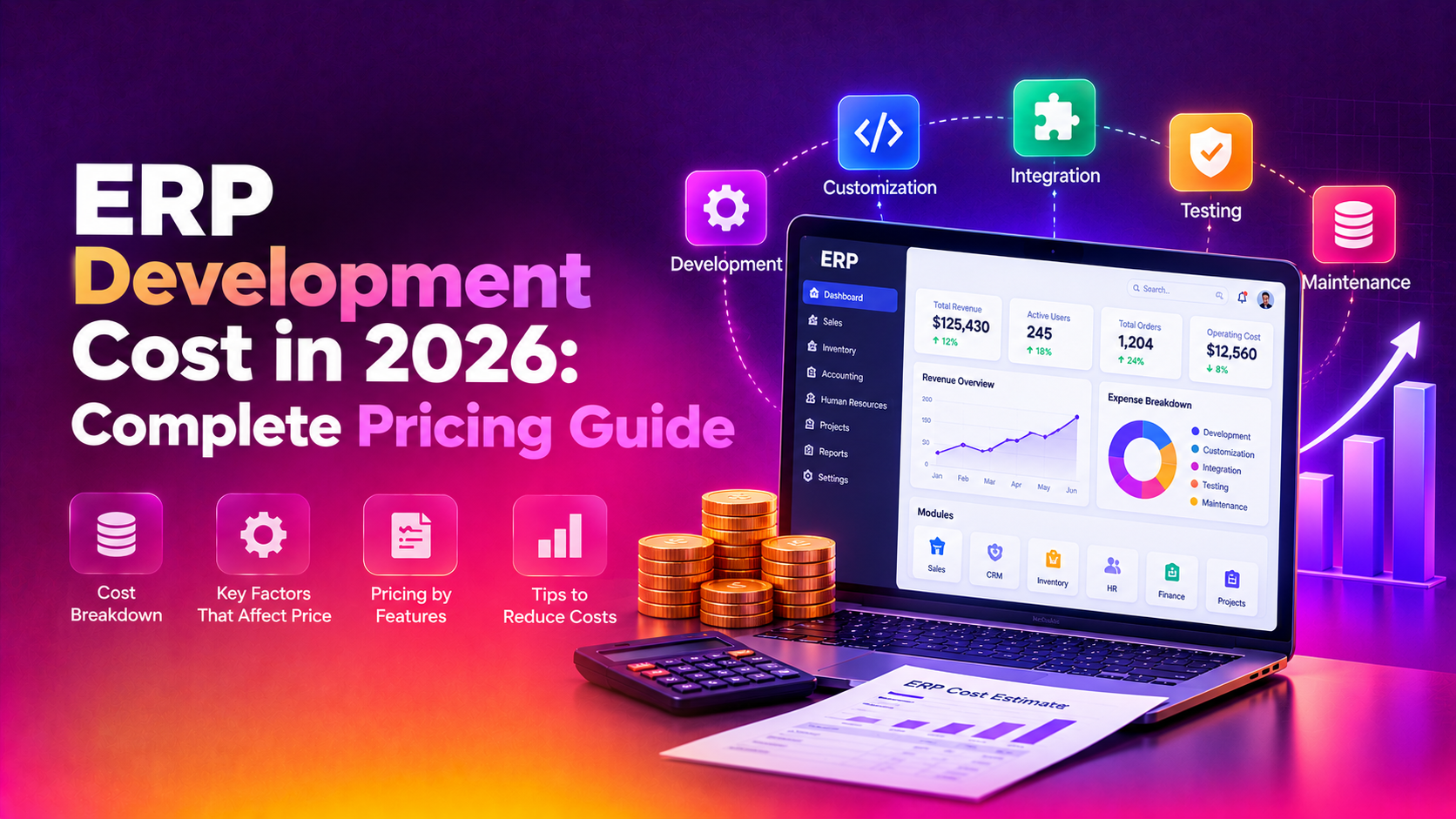
Before you can compare quotes, it helps to understand what actually moves the needle on custom ERP software cost. Five factors explain almost all of the variance between a $10,000 quote and a $1,000,000 quote:
- Number of modules — a system with just finance and inventory costs a fraction of one with finance, inventory, HR, manufacturing, CRM, and procurement combined.
- Customization depth — an off-the-shelf module configured to your workflow is cheap; a module rebuilt around your unique approval chains and industry rules is not.
- Integrations — connecting to your existing accounting software, e-commerce platform, payment gateway, or legacy database each adds engineering time (and risk).
- Data migration complexity — moving ten years of messy spreadsheets and a legacy database into a clean ERP schema is routinely underestimated.
- Developer location and team structure — North American teams typically bill $80–$150/hour, Eastern European teams $40–$70/hour, and South Asian teams (including Kerala-based teams like CloudHouse) $25–$50/hour for comparable senior-level work.
Industry-wide, the implementation budget breaks down roughly as 40–50% on the actual software build, 15–25% on integrations, 10–15% on data migration, 5–10% on training, and the remainder on change management and project buffer. If a vendor's quote doesn't map to something like this breakdown, ask them to show their work.
It's also worth understanding who is actually doing the work behind the quote. Some agencies subcontract the build to a third-party team you'll never meet, which adds a markup layer and a communication gap when something goes wrong post-launch. Ask directly whether the people quoting the project are the same people who will be writing the code — this single question filters out a surprising number of low-quality vendors before you've spent a dollar.
ERP Development Cost Breakdown by Module/Complexity (2026)
The single biggest reason ERP quotes vary so much is that most agencies quote a single lump-sum number instead of showing you what you are actually paying for. Here is a realistic 2026 tiered breakdown by module and complexity level for a custom-built ERP (not a licensed platform):
| Module | Basic / Standard Complexity | Advanced / Highly Customized |
|---|---|---|
| Core (Finance & Accounting) | $8,000 – $20,000 | $25,000 – $60,000 |
| Inventory & Warehouse Management | $6,000 – $15,000 | $20,000 – $50,000 |
| HR & Payroll | $5,000 – $12,000 | $18,000 – $40,000 |
| CRM / Sales Pipeline | $6,000 – $14,000 | $20,000 – $45,000 |
| Manufacturing / Production Planning | $10,000 – $25,000 | $35,000 – $90,000 |
| Procurement & Vendor Management | $5,000 – $12,000 | $18,000 – $38,000 |
| Reporting & BI Dashboards | $4,000 – $10,000 | $15,000 – $35,000 |
| Third-party integrations (each) | $2,000 – $6,000 | $8,000 – $20,000 |
| Small business (3–5 modules) | $25,000 – $80,000 total | |
| Mid-market (full suite) | $150,000 – $750,000 total (year one) | |
| Enterprise (multi-site, complex compliance) | $700,000 – $3,000,000+ | |
Most small and mid-sized businesses researching erp implementation pricing india and Kerala-based development specifically land in the $25,000–$150,000 range for a genuinely custom system covering 3–6 core modules, which is significantly cheaper than the same scope built by a North American or Western European agency, without sacrificing code quality when the team has real ERP delivery experience.
Notice how the "Advanced" column is often 2.5x to 3x the "Basic" column for the exact same module name. This is precisely why two vendors can both say "we'll build your inventory module" and land $30,000 apart — one is quoting a standard stock-tracking module, the other is quoting multi-warehouse, batch-tracked, barcode-integrated inventory with automated reorder logic. Always ask a vendor to describe the complexity tier they're pricing, not just the module name.
Custom ERP vs SAP/Odoo/NetSuite Licensing Cost
A common question when budgeting the cost to build erp system is whether it's cheaper to license an established platform instead. Here's the honest comparison:
- SAP Business One / S/4HANA — Implementation alone often starts at $75,000–$250,000+ for mid-market, plus per-user licensing of roughly $150–$400/month/user indefinitely. Customization beyond SAP's configuration options is expensive and constrained by the platform's architecture.
- Odoo — Cheaper to start (community edition is free; Odoo Enterprise runs roughly $20–$40/user/month), but heavy customization for unusual workflows can eat the savings quickly, and you remain dependent on Odoo's release cycle and module marketplace.
- NetSuite — Strong for finance-heavy SaaS and multi-entity businesses, but subscription costs typically run $10,000–$100,000+/year depending on modules and users, with no cap — you are renting forever, not owning the system.
- Custom-built ERP — Higher upfront cost, but no recurring per-user licensing fees, no vendor lock-in, and the system is built exactly around your workflows instead of forcing your workflows to fit someone else's software.
The breakeven point is usually 3–5 years: if you expect to run the system for a decade with a stable user count, custom development frequently wins on total cost of ownership. If your headcount and requirements are still volatile, a licensed platform's flexibility may be worth the ongoing fees.
There is also a middle path worth knowing about: a hybrid build where core financials run on a proven open-source base like Odoo's community edition while the modules unique to your business — the ones no off-the-shelf platform handles well — are custom-built and integrated on top. This can meaningfully lower the "Basic" line items in the table above while still giving you full ownership of the parts of the system that actually differentiate your operations.
💡 None of these worked? Skip the guesswork.
Get Expert Help →Hidden Costs and Scope Creep to Watch For
This is the section most erp development pricing guide articles skip entirely, and it's the one that actually protects your budget. Watch for these:
Some vendors quote a low headline number, then bill a separate multi-week "discovery" or "requirements gathering" phase before the real quote is even issued. Ask upfront whether discovery is included in the number you were given.
Migrating years of inconsistent spreadsheets, legacy database exports, or a previous ERP's data is routinely 2–3x more time-consuming than vendors initially estimate. Get a written cap on migration hours, not a vague "included."
Every additional system you need to connect — your accounting software, payment gateway, e-commerce store, shipping carrier API — adds real engineering time. If your quote lists "integrations" as a single line item with no per-system breakdown, that's a red flag.
Many quotes cover build cost but go silent on what happens after go-live. Confirm what warranty period is included and what an hour of post-launch support costs afterward.
This is the classic scope-creep trap: you ask for "one small change" mid-project, it seems reasonable, and six of those later your budget has ballooned by 40%. Insist on a written change-order process with per-change cost and timeline impact before work starts, not after.
A practical safeguard against all five of these is to insist on a fixed-scope statement of work broken down by the same module/complexity structure shown in the pricing table above, with an explicit hourly rate and approval process for anything outside that scope. A vendor who resists putting this in writing before you sign is telling you something important about how the project will be run once you've paid the deposit.
Why Businesses Choose CloudHouse for Custom ERP Development
CloudHouse Technologies builds custom ERP systems with fixed-scope, module-level quotes instead of vague lump sums, so clients can see exactly what they are paying for before signing. Because the team is based in Kerala, clients get senior-level engineering at South Asian hourly rates without giving up direct communication, documented change-order processes, and a defined post-launch support window — the exact protections this guide recommends checking for in any vendor.
Just as importantly, CloudHouse scopes projects module by module using the same complexity tiers shown earlier in this guide, so a client comparing a CloudHouse proposal against a competing quote can see precisely where the numbers diverge — whether that's a difference in customization depth, integration count, or migration scope — instead of trying to reconcile two unrelated lump sums.
Frequently Asked Questions
Conclusion
ERP development cost in 2026 is not a mystery once you break it down by module and complexity: a small business can expect $25,000–$80,000 for a genuinely custom system, mid-market implementations run $150,000–$750,000, and licensing platforms like SAP or NetSuite trade a lower upfront cost for indefinite per-user fees. The real risk to your budget isn't the headline number — it's unclear discovery phases, underestimated data migration, and undocumented change requests. Get a module-level, written quote before you sign anything, and talk to CloudHouse about a fixed-scope ERP development quote built around your actual modules, not a guess.