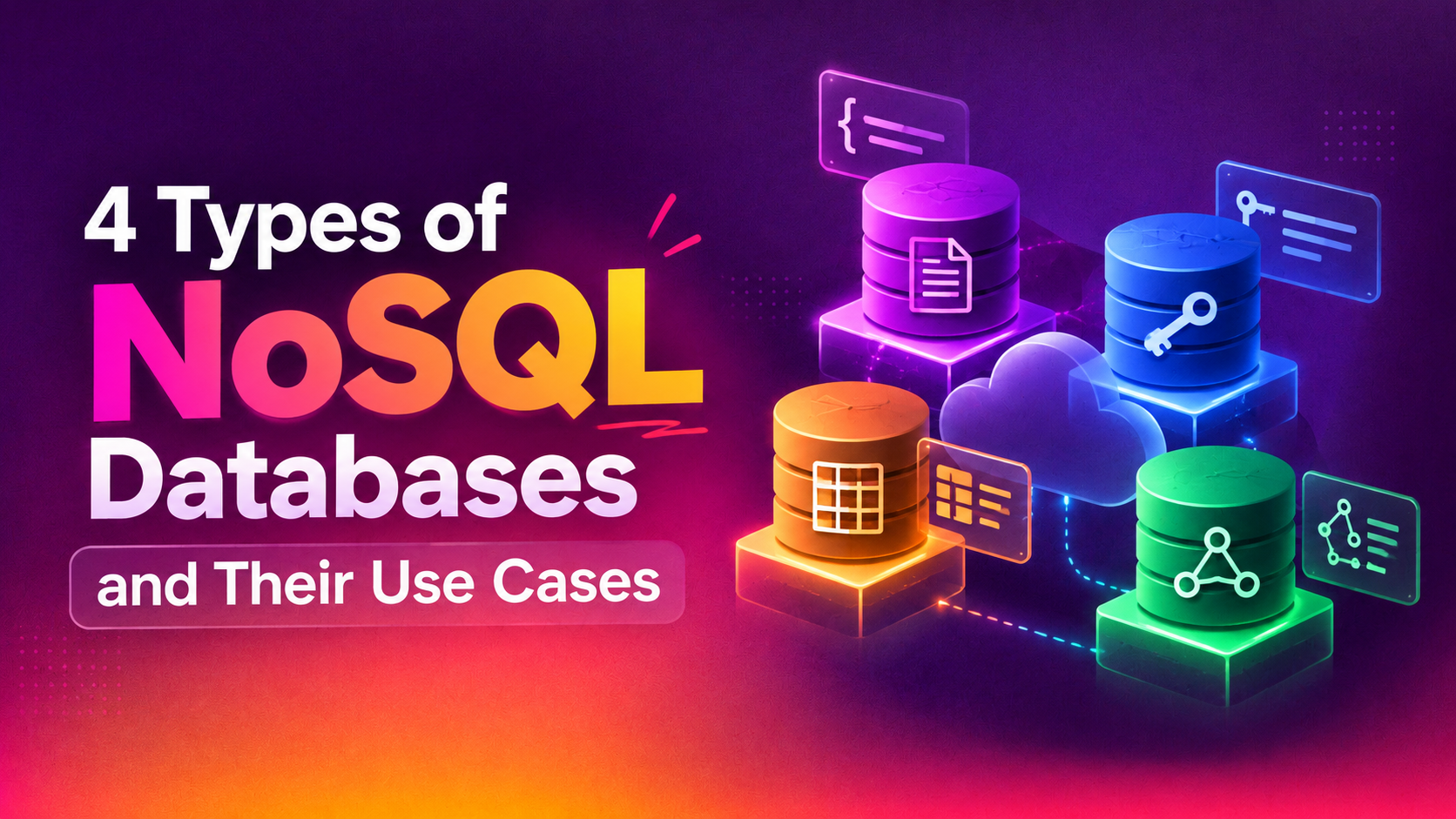
The four main types of NoSQL database are document, key-value, wide-column and graph, and each one fits a different kind of workload. Choose by how your application reads and writes data, not by which product is most popular. NoSQL databases are built for the "three Vs": Volume, Velocity, and Variety. Unlike traditional SQL databases with a fixed table structure, they use flexible data models and can scale horizontally across many servers.
As of 2026, these four types are still the standard way to classify NoSQL systems, and each solves a specific technical challenge. Many modern products now support more than one data model, so treat the categories below as a guide to each database's core strength rather than a strict boundary.
1. Document Databases
Document databases store data in flexible, semi-structured records, typically using JSON or BSON (Binary JSON). Every "document" is a self-contained unit that can hold different fields than its neighbors, making this the most intuitive type for developers. You can change the shape of your data without running a schema migration across the whole database.
Popular Examples: MongoDB, Amazon DocumentDB, Couchbase.
Key Use Cases:
Content Management Systems (CMS): Storing diverse content like articles, videos, and comments in one place, without forcing every item into the same columns.
E-commerce Catalogs: Managing products where a "Shirt" has a size, but a "Laptop" has RAM and a Processor. Each product document carries only the fields that apply to it.
Real-Time Analytics: Storing high-speed user profile data that changes frequently, where the structure of each record evolves over time.
2. Key-Value Stores
This is the simplest form of NoSQL. Data is stored as a collection of Key-Value pairs, much like a dictionary. You provide a unique key, and the database returns the associated value (which could be a string, a number, or even an image). Because there are no complex queries or joins to plan, lookups are extremely fast and easy to scale.
Popular Examples: Redis, Amazon DynamoDB, Memcached.
Key Use Cases:
Caching: Temporarily storing frequently accessed data to speed up website load times and reduce load on your primary database.
Session Management: Keeping track of user logins and shopping carts in real-time, so users stay signed in as requests move between servers.
Leaderboards: Managing high-speed scoring for online gaming or real-time voting, where rankings must update instantly.
3. Wide-Column (Column-Family) Stores
While SQL databases store data in rows, these databases store data in Columns. This allows for extremely efficient data compression and very fast "reads" across specific datasets, even when those datasets involve petabytes of information. They are also designed to spread data across many nodes, which makes heavy write workloads practical.
Popular Examples: Apache Cassandra, Google Bigtable, ScyllaDB.
Key Use Cases:
IoT & Sensor Data: Collecting massive streams of time-series data from millions of devices that write continuously.
Financial Tick Data: Storing high-frequency stock market updates that arrive in huge volumes and must be queried by time range.
Log Management: Aggregating system logs from thousands of distributed servers for forensic analysis and troubleshooting.
4. Graph Databases
Graph databases focus on the relationships between data points rather than the data points themselves. They use "Nodes" (entities) and "Edges" (relationships) to create a web of interconnected information that is much faster to query than using complex SQL joins. When your questions sound like "who is connected to whom, and how?", a graph database is usually the right fit.
Popular Examples: Neo4j, Amazon Neptune, ArangoDB.
Key Use Cases:
Social Networks: Mapping "Friends of Friends" or suggesting new connections between people.
Fraud Detection: Identifying suspicious patterns in banking transactions to spot money laundering, by following links between accounts, devices and payments.
Recommendation Engines: Linking products together based on user behavior and shared attributes.
Quick Comparison Summary
Document Databases Best for flexibility and rapid prototyping. They map directly to application code objects, making development faster.
Key-Value Stores Best for performance and simplicity. They provide the lowest possible latency for simple data lookups.
Wide-Column Stores Best for scale and analytical scans. They are designed to handle massive write and read throughput across big data.
Graph Databases Best for connectivity and patterns. They can navigate complex, multi-layered relationships in mere milliseconds.
In practice, many production systems combine several of these types. For example, a site might keep its main records in a document database and put a key-value store in front of it as a cache. Start with the access pattern your application needs most, then pick the type that serves it best.
![Fix Windows 0x80004005 error [SOLVED]](https://strapise.cloudhousetechnologies.com/uploads/banner_fix_windows_0x80004005_error_9c97b9a4c9.png)